
Azolla was first described in 1883 by the French naturalist Jean-Baptiste Lamarck. In Vietnam, during the 1960s movement promoting agricultural production to build the nation, azolla was one of the most widely promoted green manure crops and appeared in almost all rural areas. Let's explore the role and applications of azolla in organic agricultural production.
Azolla in organic farming
History of using azolla in farming
In recent years, the supply of organic fertilizers has become one of the decisive factors in the organic production process, and one of the biggest challenges in organic fertilization is organic nitrogen. In practice, we can utilize processed forms of animal-based nitrogen. However, following ecological principles, this may not be a sustainable solution. Therefore, we need to find more sustainable alternatives. Using Azolla as fertilizer to provide an organic nitrogen source is one such sustainable and effective solution, as Azolla fixes atmospheric nitrogen for its own use through its symbiosis with blue-green algae in its fronds. When properly applied, Azolla plays an enormous role with valuable applications in organic agriculture.
_What is Azolla (fairy moss)?_
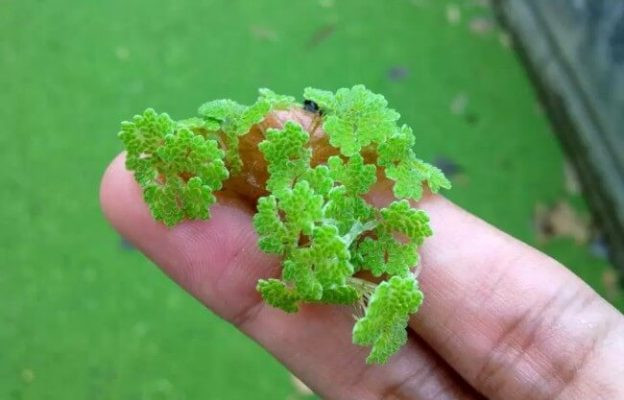
Azolla (also known as mosquito fern, scientific name Azolla sp.) is an aquatic fern that lives in symbiosis with the nitrogen-fixing blue-green alga (cyanobacteria) Anabaena azollae. Azolla was first described in 1883 by French naturalist Jean-Baptiste Lamarck. In Vietnam during the 1960s, amid the movement promoting agricultural production for national construction, azolla was one of the most vigorously promoted green manure plants and appeared across most rural areas. Azolla ranges in length from 1 to 2.5 cm, with a main axis branching into secondary axes; all axes feature small, alternating leaves, branched rhizomes, and abscission zones that allow branches to detach and grow into independent plants. This is also the reproductive mechanism of azolla.
_Figure 1: Azolla A( a: green A. filiculoides, b: red A. filiculoides), B ( a: red A. pinnata, b: red A.pinnata)_
_(Nham Tran 2020)_
The role of azolla in organic agriculture
Nitrogen is one of the indispensable macronutrients for plant growth. The atmosphere contains up to 78% free nitrogen, but most plants cannot utilize it because they can only absorb nitrogen in the forms of nitrate (NO3-) and ammonium (NH4+). Through an extraordinary evolutionary adaptation, Azolla (duckweed fern) possesses the unique ability to fix nitrogen from the air into a usable nitrogen source for itself through a symbiotic relationship with blue-green algae. As Azolla decomposes, it supplies an abundant source of nitrogen for other plants to use. According to research, cultivating Azolla requires no fertilizer application (Pereira et al. 2011, Nham Tran 2021), yet 1 hectare of cultivated Azolla can provide 1,100 kg of available nitrogen per year for crops.
Uses of azolla in organic agriculture
1\. Make organic fertilizer:
In recent years, as ecological and environmental issues have been raised everywhere, people have begun searching for natural fertilizer sources to replace chemical fertilizers. Enormous sources of natural macronutrients include potassium in banana trunks, kitchen ash, and wild sunflowers; nitrogen naturally available in leguminous plants with symbiotic root nodules; and a massive source of nitrogen in Azolla (fairy moss) that cannot be overlooked. Azolla is a wonderful organic fertilizer source permitted in organic farming; it easily replaces synthetic nitrogen sources and, importantly, allows farmers to be self-sufficient. Its cultivation technique is simple, with a high capacity to synthesize atmospheric nitrogen that accumulates in its fronds. Therefore, cultivating and using Azolla is an ideal application for sustainable and effective organic production.
2\. Animal Feed
Azolla has a high protein content of 25–30% of its dry weight and an amino acid profile comparable to that of soybeans (Nham Tran 2020, 2021). Notably, its contents of Ca, P, K, Mn, and Zn are all high. The Mn content in meal prepared from various azolla varieties is significantly higher than that of other aquatic plants and leafy greens; hence, azolla has been studied as a feed source for various livestock and animals, including goats, pigs, rabbits, chickens, ducks, shrimp, and fish. According to the scientific journal of the National Institute of Animal Science, one kilogram of fresh azolla has a nutritional value equivalent to 0.05–0.07 feed units (FU). Thus, one hectare of cultivated azolla per season can yield 6,000–9,000 FU. Clearly, using fresh azolla to feed pigs and ducks offers significant economic value, especially for breeding sows.
Research by Srinivas Kumar (2012) replacing 25% of total protein in male buffalo feed rations with dried azolla, and research replacing up to 50% of feed with azolla for calves and buffaloes (Indira et al. 2009), showed no adverse effects on livestock. However, side effects were reported when using more than 20% azolla powder to replace total protein for goats (Samanta & Tamang 1995). In addition, using azolla as cattle feed was reported to improve milk yield (Chatterjee et al. 2013; Gowda et al. 2015; Mathur, Sharma & Choudhary 2013), and its use as rabbit feed has also been documented (Ramesh et al. 2011). Studies on fish and shrimp meal showed that Azolla replaced 10–30% of protein without any adverse effects (Radhakrishnan et al. 2014; Sudaryono 2011). Notably, azolla can be used to replace 100% of soybean meal for black tiger shrimp due to its similarity to soy protein.
Therefore, it can be confidently stated that besides being an effective organic fertilizer, azolla can also be an excellent organic feed source for livestock—an alternative solution in sustainable organic agricultural development.


Need advice on PGS certification?
Contact the PGS Vietnam Coordination Committee for support.
Contact now