
The “Organic Agriculture Development Project” was funded by Agricultural Development Denmark Asia (ADDA) — a Danish non-governmental organization — and implemented in cooperation with the Vietnam Farmers’ Union from November 2005 to October 2012 in the northern provinces and cities of Hanoi, Vinh Phuc, Bac Ninh, Bac Giang, Hai Phong, Hoa Binh, Tuyen Quang, Lao Cai, and Ha Tinh.
From November 2010 to December 2012, the Project selected potential farmer groups with a genuine desire and determination to practice organic agriculture in Soc Son (Hanoi) and Luong Son (Hoa Binh) to continue consolidating and developing organic production sustainably.
1. Project objectives
Organic production and market framework
Establish an appropriate production and market framework for organic agriculture that is appreciated by both producers and consumers.
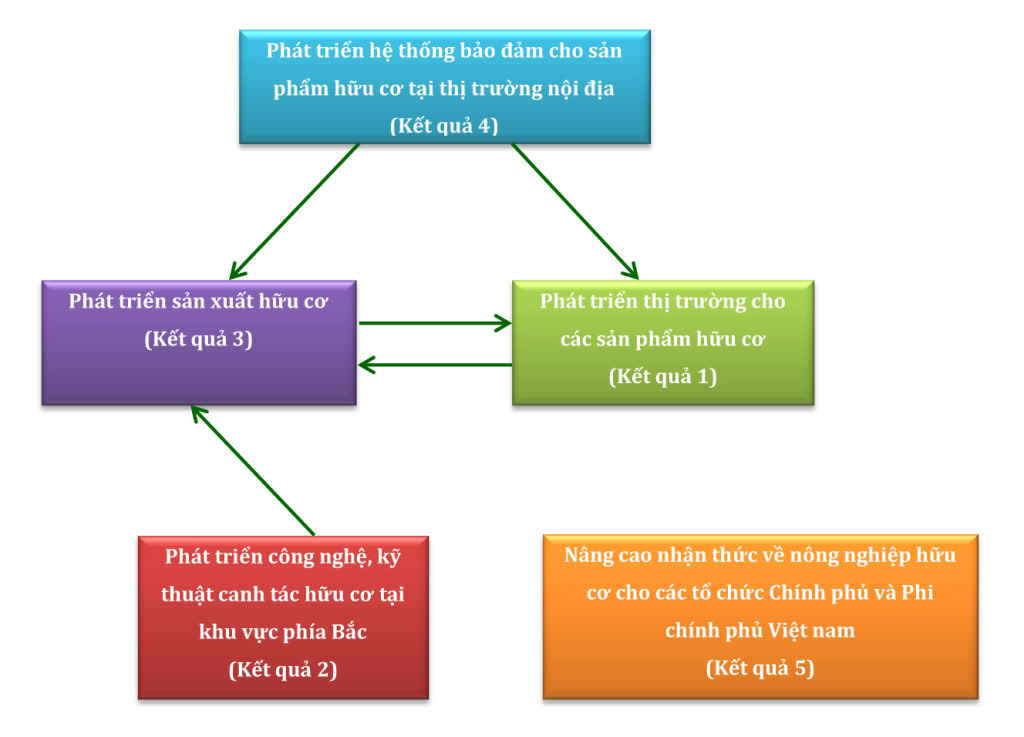
2. Expected project results (in interactive relationships)
3. Production development
- Conduct surveys and implement field trials to identify organic farming practices suited to natural and social conditions in Northern Vietnam.
- Developing an organic agriculture curriculum to train master trainers (80 farmer trainers) and coach more than 4,000 farmers in organic farming methods for vegetables, fruit trees (longan, pomelo), tea, and fish.
- Established more than 80 organic farmer groups across areas meeting environmental and human criteria.
- Currently, there are 25 production groups in Soc Son and Luong Son supplying organic fruits and vegetables to the Hanoi market.
- The monthly income of farmers participating in the project increased by 50% - 100%.
4. Market development
Phase 1 (2008 – 2009): Raising consumer awareness and increasing demand for organic products. In 2009, monthly consumption of organic vegetables and fruits reached 8–10 tons; by 2010, this figure doubled to 18–20 tons/month. Activities included trade fairs, field visits, and social marketing campaigns.
Phase 2 (2009 – 2010): Linking producer groups to the market through distribution enterprises. Activities aimed at developing supply chains. The number of organic vegetable distribution companies increased from 4 in 2009 to 8 in 2010 and continued to grow.
5. Developing the Participatory Guarantee System (PGS) for organic products
Specific activities (2009–2011): Developing the PGS system: organizational structure, setting standards, monitoring and evaluation methods, templates and forms, registration procedures...; Inspector training: 75 farmer inspectors trained; Decision-making and issuing PGS certificates to compliant units.
- The method requires the participation of multiple stakeholders—farmers, businesses, consumers, and more—with low costs but requiring substantial time.
- An internal system, applicable only to participating stakeholders (including supermarkets).
- In 2008, stakeholders agreed to establish the PGS (Participatory Guarantee System) as a quality assurance system for organic products.
6. Evaluation results and PGS certification issuance
- In 2009: 13 groups registered and applied for PGS certification, but only 1 group, Bai Thuong (Soc Son), was certified.
- From 2010 to 2011: 25 producer groups with over 240 farmers completed registration procedures for PGS certification. Following inspection procedures, 16 vegetable groups, 1 longan group, and 1 pomelo group were granted PGS organic certification. The certified PGS groups were primarily located in Soc Son and Luong Son.
- Periodic inspections and annual inspections: 1 group had its certification suspended (due to parallel production), 2 groups were issued warnings, and 16 groups were recertified.
- The PGS Coordination Committee and inter-groups collect vegetable samples for testing abnormal residues whenever necessary.
- From 2011 to 2012: The project continued to support groups in developing production, especially in monitoring and quality management to meet PGS standards in Soc Son District (Hanoi) and Luong Son District (Hoa Binh Province).
- Select eligible farmers within organic groups to pilot integrated models combining organic vegetable farming with organic chicken, pig, and rice production, aiming to gradually transition farmers towards a closed-loop organic farming system encompassing both crop production and animal husbandry.
Need advice on PGS certification?
Contact the PGS Vietnam Coordination Committee for support.
Contact now