
In life, perhaps not many people enjoy being inspected and monitored; yet in the organic vegetable village of Thanh Xuan commune, Soc Son, Hanoi, farmers consider the inspectors and supervisors their "treasured assets."
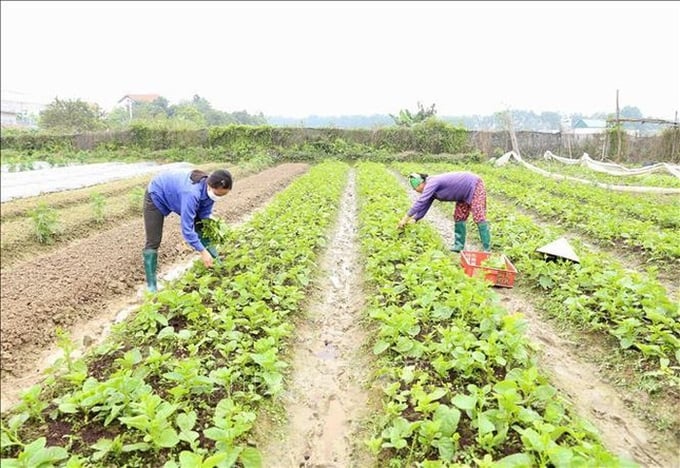
Inspection in organic vegetable production
The role of inspectors in the Thanh Xuan vegetable production area
Recently, the clean food chain Soi Bien held an appreciation ceremony for farmers of the Thanh Xuan Organic Vegetable Inter-group in Thanh Xuan Commune, Soc Son District, Hanoi.
Along with the gratitude ceremony was a seminar attended by representatives of organic vegetable farmer groups in Thanh Xuan commune to share the farmers' heartfelt thoughts.
Many stories were shared by the representatives, ranging from difficulties and advantages to product consumption. In particular, in response to the MC's question about how farmers resolved the market access issue so that consumers and the market would accept their products, Ms. Nguyen Thi Minh Dung, head of the Hoa Ly group, shared a story that received warm applause from the entire hall about systematic organic vegetable farming in Thanh Xuan commune and the wonderful awareness of local farmers.
According to Ms. Dung, the organic vegetable cultivation process is very rigorous; organic farming is not industrialised but entirely manual. Throughout more than 14 years of growing organic vegetables, local farmers have received enthusiastic support from PGS Vietnam (Participatory Guarantee System), led by Head of Coordination Board Ms. Tu Thi Tuyet Nhung—one of the "treasures" of organic vegetable farmers in Thanh Xuan, who has always devotedly accompanied them.
Ms. Dung shared that PGS itself acts as a bridge among three parties: producers, consumers, and buyers/distributors, functioning to inspect and supervise Thanh Xuan organic vegetable products.
Agreeing with Ms. Dung, Mr. Nguyen Van Vien, leader of the Thanh Cong group, said that only with such thorough inspection and oversight by PGS could the Thanh Xuan Organic Vegetable Intergroup survive and thrive as it does today.
According to Mr. Vien, without inspection and monitoring, he and the local farmers probably would not have succeeded. The more inspections and oversight there are, the happier they feel, because PGS assurance is the key to bringing Thanh Xuan organic vegetables to the market. Representing the farmers, he wholeheartedly supports as much inspection and monitoring as possible to ensure output quality.
Deeply touched by the community's affection for PGS, Ms. Tu Thi Tuyet Nhung shared several very useful pieces of information about PGS during the speaker panel discussion.
According to the "captain" of PGS Vietnam, organic farming is extremely challenging for farmers because they must strictly adhere to standards for produce to be certified organic, which involves immense hardship and effort. But once produced, figuring out how to sell it becomes a major challenge, as one cannot simply bring an unlabeled organic product to market—who would believe it?
Therefore, standards and certification systems are needed to help farmers find market outlets once they produce well. That is why PGS Vietnam was established in 2008 with the support of the world's largest organic agriculture organization, IFOAM Organics International, known as the "Participatory Guarantee System", abbreviated as PGS.
Ms. Nhung stated that the participants who monitor and grant PGS certification are the farmers themselves, not external inspectors. In the PGS system, farmers must directly participate in the monitoring and inspection process and take responsibility for the products they produce.
In addition, the role of PGS is not only to assess, monitor quality, and grant certificates, but also to connect farmers with the market, unlike third-party certification systems that only assess and issue certificates.
In particular, the current PGS system serves a deeply people-centered purpose: helping farmers build their own capacity and ensure quality themselves, with oversight from stakeholders. PGS is not a system in which farmers issue their own certificates; rather, stakeholders jointly review, inspect and monitor to reach decisions.
Therefore, PGS was created to help farmers evaluate their own quality and connect them with the market through retailers. Currently, PGS is present in hundreds of countries worldwide, including advanced nations such as the US, Japan, Australia, the EU...
Finally, Ms. Tu Thi Tuyet Nhung expressed her gratitude to the farmers for their determination and bold spirit, which have earned Thanh Xuan organic vegetable products a strong reputation in the market today.

Need advice on PGS certification?
Contact the PGS Vietnam Coordination Committee for support.
Contact now