
Traceability of goods to combat unsafe food during the Lunar New Year
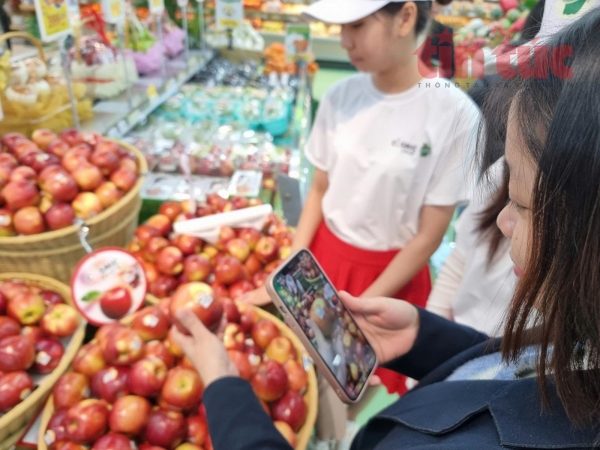
Consumers trace origins by scanning QR codes.
Through the application of barcodes, QR codes, and new management tools, competent authorities are step-by-step enhancing product transparency, protecting consumers' rights and health.
Strengthening quality management tools
Dr. Trần Hậu Ngọc, Vice Chairman of the National Commission for Standards, Metrology and Quality, stated that the Ministry of Science and Technology has comprehensively implemented tasks directed by the Government to strengthen quality control over goods, particularly food products serving the Tet holiday.
Specifically, implementing Directive No. 36/CT-TTg dated 31/12/2025 of the Prime Minister on organizing a joyful, healthy, safe, and economical Bính Ngọ Lunar New Year 2026, and the directives of Deputy Prime Minister Bùi Thanh Sơn, Head of the National Steering Committee 389, in Official Letter No. 11554/VPCP-V.I dated 25/11/2025 on enhancing the effectiveness of anti-smuggling, commercial fraud, and counterfeit goods efforts before, during, and after the Lunar New Year, the Ministry of Science and Technology issued Official Letter No. 7896/BKHCN-VP dated 23/12/2025 to guide implementation.
The National Commission for Standards, Metrology and Quality is actively carrying out tasks as prescribed, while coordinating the implementation of Plan No. 1941/KH-BCĐTƯATTP dated 23/12/2025 of the Central Inter-sectoral Steering Committee on Food Safety during the Bính Ngọ Lunar New Year and the Spring Festival season of 2026.
Within the framework of this plan, the Commission has dispatched officers to join inter-agency inspection teams led by the Ministry of Industry and Trade and the Ministry of Health in the provinces of Đắk Lắk, Lâm Đồng, Tuyên Quang, and Lào Cai, to inspect and evaluate local food safety assurance work. These inspection activities aim to serve people celebrating Tet and enjoying spring safely, safeguarding health, and contributing to creating a fair, healthy competitive environment among food production and business establishments.
Assessing state management in the field of product and goods quality, Dr. Trần Hậu Ngọc noted that recently, this work has been implemented strictly and rigorously, yielding many positive results and raising the quality of goods circulating in the market.
Fruits sold in supermarkets with traceability labels attached.However, in the face of complex developments in counterfeit and poor-quality goods—especially in e-commerce environments—coupled with management requirements in the context of robust digital transformation, the National Commission for Standards, Metrology and Quality advised the Ministry of Science and Technology to submit to competent authorities the Law amending and supplementing a number of articles of the Law on Standards and Technical Regulations (Law No. 70/2025/QH15 dated 14/6/2025) and the Law amending and supplementing a number of articles of the Law on Product and Goods Quality (Law No. 78/2025/QH15 dated 18/6/2025). Both laws come into effect on 1/1/2026.
According to Dr. Trần Hậu Ngọc, the laws have added numerous advanced management tools, including: classifying products and goods into three risk levels; traceability; digital labeling and product digital passports; and building a national product and goods quality supervision system.
Applying barcodes, QR codes, along with traceability solutions, digital labels, and digital passports helps identify products and make information on origins and production processes transparent, especially for goods traded on digital platforms; boosting food quality control and consumer protection.
Traceability and metrology protect consumer rights
According to leaders of the National Commission for Standards, Metrology and Quality, the Ministry of Science and Technology has currently published 1,173 valid national standards (TCVN) on food, including 16 TCVN on food safety, 33 TCVN on traceability, and 25 TCVN on barcodes. These serve as crucial foundations for people to choose products conforming to technical standards and regulations, prioritizing goods with standard and regulation conformity declarations and complete labeling.
Once the national product and goods quality supervision system operates synchronously, it will enable early detection and timely warning of counterfeit goods, substandard items, and unsafe food. The system is built on integrated data of technical standards and regulations; inspection and calibration results; conformity assessments; quality inspections; risk warnings; feedback and complaints from consumers and social organizations; along with data on barcodes, traceability, digital labels, and product digital passports.
An event at a supermarket introducing new product origins.In addition, Dr. Trần Hậu Ngọc emphasized the special role of metrology in commercial food transactions. “Metrology plays the role of 'weighing, measuring, and counting', ensuring the quantity and volume of goods as well as openness and transparency between buyers and sellers. Therefore, metrology is an indispensable factor in food trading activities,” affirmed Dr. Ngọc.
According to recommendations from the Vice Chairman of the National Commission for Standards, Metrology and Quality, for pre-packaged food, consumers should select products with complete, clear labels stating mass, volume, and quantitative content in accordance with regulations. For non-pre-packaged food, priority should be given to purchasing at establishments using measuring instruments inspected and verified by competent authorities with valid verification certificates. This is a practical way for people to protect their legitimate rights and contribute to building a safe, transparent consumer environment during the Lunar New Year.