
The “Organic Agriculture Development Project” was funded by the Agricultural Development Denmark Asia (ADDA) — a Danish NGO, implemented in coordination with the Vietnam Farmers' Union from November 2005 to October 2012 in Northern provinces including: Hà Nội, Vĩnh Phúc, Bắc Ninh, Bắc Giang, Hải Phòng, Hòa Bình, Tuyên Quang, Lào Cai, and Hà Tĩnh.
From November 2010 to December 2012, the Project selected potential farmer groups who were truly committed and determined to practice organic farming in Sóc Sơn (Hà Nội) and Lương Sơn (Hòa Bình) to continue strengthening and developing organic production sustainably.
1. Project Objectives
Organic production and market framework
Establish an appropriate production and market framework for organic agriculture that is highly valued by both producers and consumers.
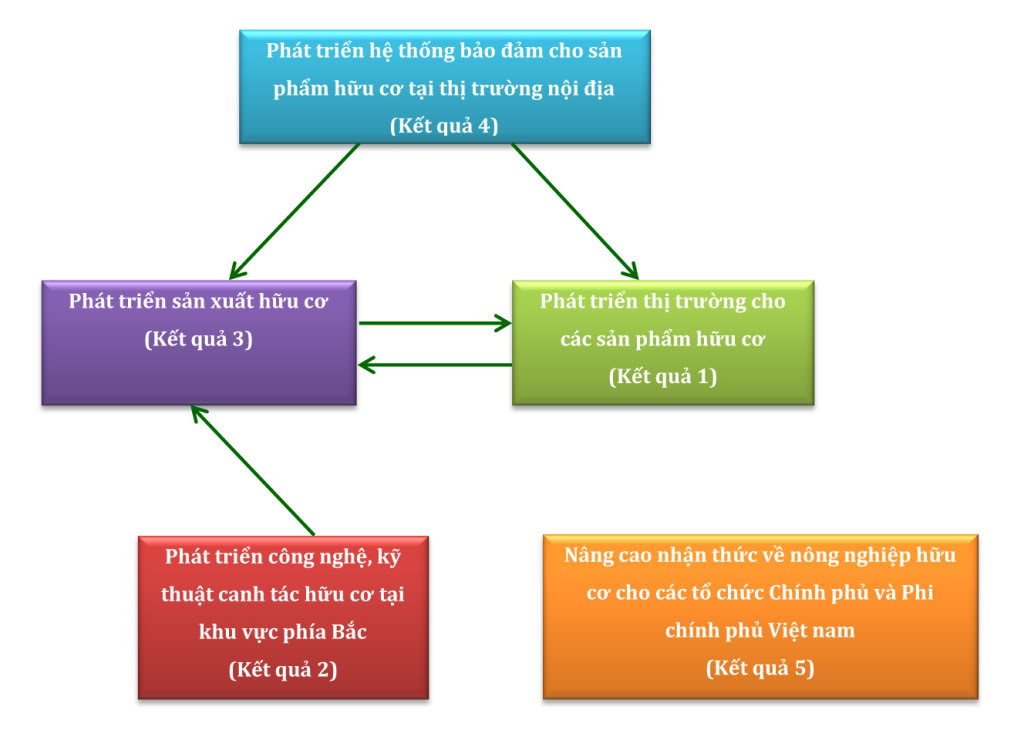
2. Expected Project Outcomes (in interaction)
3. Production Development
- Conduct surveys and field trials to determine organic farming practices suitable for the natural and social conditions in Northern Vietnam.
- Develop organic agriculture curricula to train master trainers (80 farmer trainers) and train over 4,000 farmers in organic farming methods for vegetables, fruit trees (longan, pomelo), tea, and fish.
- Establish over 80 organic farmer groups in areas with suitable environmental and human conditions.
- Currently, there are 25 production groups in Sóc Sơn and Lương Sơn areas supplying organic vegetables and fruits to the Hà Nội market.
- Monthly income of farmers participating in the project increased by 50% - 100%.
4. Market Development
Phase 1 (2008 – 2009): Raising consumer awareness and increasing demand for organic products. In 2009, the monthly consumption of organic vegetables and fruits reached 8-10 tons; by 2010, this figure doubled to 18-20 tons/month. Activities included: trade fairs, field visits, and social marketing campaigns.
Phase 2 (2009 – 2010): Linking production groups with the market through distribution businesses. Activities aimed at developing the supply chain. The number of organic vegetable distribution companies increased from 4 companies in 2009 to 8 companies in 2010 and continues to grow.
5. Development of the Participatory Guarantee System (PGS)
Specific activities (2009 – 2011): Developing the PGS system: organizational structure, setting standards, monitoring and evaluation methods, forms, registration procedures...; Inspector training: 75 farmer inspectors were trained; Decision-making and issuing PGS certification for units meeting the standards.
- The method requires the participation of multiple parties: farmers, businesses, consumers... with low costs but requiring significant time.
- It is an internal system, applied only to participating stakeholders (including supermarkets).
- In 2008, stakeholders agreed to establish the PGS (Participatory Guarantee System) as an organic product quality assurance system.
6. PGS Assessment and Certification Results
- 2009: 13 groups registered and applied for PGS certification, but only one group, Bái Thượng (Sóc Sơn), was certified.
- From 2010 – 2011: 25 production groups with more than 240 farmers completed the PGS certification registration procedures. After inspection procedures, 16 vegetable groups, 1 longan group, and 1 pomelo group were granted PGS organic certification. The PGS certified groups were mainly located in Sóc Sơn and Lương Sơn.
- Periodic and annual inspections: 1 group had its certification suspended (due to parallel production), 2 groups received warnings, and 16 groups were re-certified.
- The PGS Coordination Board, along with inter-groups, collects vegetable samples to check for abnormal residues when necessary.
- From 2011 – 2012: The project continued to support groups in production development, especially in monitoring and quality management to meet PGS standards in Sóc Sơn district (Hà Nội City) and Lương Sơn district (Hòa Bình Province).
- Selecting eligible farmers from organic groups to pilot models combining organic vegetable cultivation with chicken and pig farming and organic rice, aiming to gradually transition farmers to a closed-loop organic farming system including both crops and livestock.