
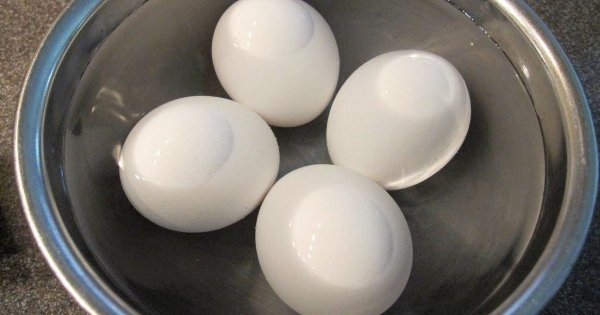
Should boiled eggs be soaked in cold water?
There have been claims suggesting that soaking eggs in cold water could contaminate them with bacteria and harm health.
Soaking boiled eggs in cold water is a popular tip used by many to peel eggs quickly and neatly. However, claims have recently surfaced that this practice might allow bacteria from the water to penetrate inside the egg, negatively impacting health. Is this true?
Why does soaking in cold water make eggs easier to peel?
When eggs are hard-boiled at high temperatures, the proteins in the egg white and yolk coagulate and shrink slightly in volume. If placed in cold water immediately after boiling, the temperature difference causes the inside of the egg to contract faster than the outer shell.
This thermal contraction creates a small gap between the egg membrane and the shell, allowing water to seep into that space. As a result, the shell separates from the egg white more easily, preventing the white from sticking to the shell during peeling.
Conversely, without cooling them in cold water, the egg membrane often adheres tightly to the shell, making peeling difficult and leaving the egg unappealing.
Does soaking eggs in cold water increase the risk of bacterial contamination?
Some opinions argue that boiled eggs should not be soaked in cold water because the eggshell contains thousands of tiny pores. When hot eggs are plunged into cold water, the sudden drop in internal pressure may create a suction force that draws bacteria from the water through the pores into the egg.
If unboiled tap water or unsanitary ice is used, bacteria such as Salmonella or E. coli risk entering the egg white, increasing the chances of food poisoning, stomach ache, or diarrhea.
However, according to Assoc. Prof. Dr. Nguyễn Duy Thịnh, a food technology expert and former lecturer at the School of Biotechnology and Food Technology (Hanoi University of Science and Technology), the notion that soaking eggs in cold water "forces toxins from the shell into the egg" is unfounded speculation lacking scientific basis.
He stated that for many years, soaking eggs after boiling to cool them quickly has been a common household practice. What truly matters is not whether cold water is used, but that the water source is clean and ensures proper hygiene.
Tips for properly soaking eggs for easy peeling and safety
To minimize the risk of bacterial contamination and make eggs easy to peel, home cooks should keep several principles in mind:
-
Wash eggshells thoroughly before boiling to remove dirt and bacteria clinging to the surface.
-
Add a little salt to the boiling water if desired.
-
Place eggs in the pot while the water is still cold, then turn on the stove to reduce the risk of shells cracking.
-
Boil for about 10 minutes for hard-boiled eggs; about 6 minutes for soft-boiled eggs.
After boiling:
-
Only soak eggs in cooled boiled water, clean filtered water, or ice water made from a purified water source.
-
Avoid soaking directly in untreated tap water if the water quality is not guaranteed.
-
Soak for only about 3–5 minutes, until the shells are cool enough to peel comfortably.
If not consuming immediately, leave the shells on, wipe them dry, store in an airtight container in the refrigerator, and consume preferably within 24 hours to ensure quality and food safety.