
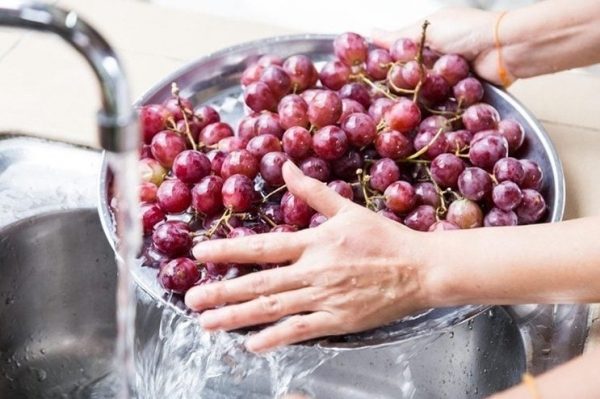
How to remove pesticide residues from grapes and strawberries
1. Why pay special attention when washing grapes and strawberries?
Over many years, food safety monitoring programs in the United States and Europe have shown that strawberries and grapes are often in the group of fruits where pesticide residues are detected at higher levels compared to some other fruits. However, it should be stated that the majority of legally circulated products fall within safe limits according to regulations.
Nevertheless, grapes grow in clusters with many crevices, and strawberries have a porous surface with many seeds on the skin – these factors make it easy for dirt, bacteria, and chemical residues to cling. Therefore, proper cleaning is a vital step in ensuring food safety.
2. Methods for removing residues on grapes and strawberries
Here are 5 methods to reduce pesticide residues on the surface of grapes and strawberries:
2.1. Soaking grapes and strawberries in a diluted salt solution
This is a traditional method, easy to perform, and suitable for home settings.
How to do it:
Mix 1–2 teaspoons of salt into about 1–1.5 liters of clean water.
Soak the grapes or strawberries for 10–15 minutes.
Then rinse thoroughly under running water.
The mechanism of salt water is mainly to change osmotic pressure, helping to loosen dirt, insect eggs, and some surface residues. For grapes, the solution can penetrate between the clusters, increasing cleaning efficiency.
However, salt water does not have the ability to "neutralize" or decompose most pesticides with stable structures. Therefore, the step of rinsing with running water is mandatory to completely remove salt residue and impurities.
2.2. Soaking in baking soda solution (sodium bicarbonate)
Several experimental studies show that a baking soda solution can help decompose or reduce certain pesticide active ingredients on the fruit surface.
How to do it:
Dissolve 1 teaspoon of baking soda in about 500 ml of water.
Soak the fruit for 10–15 minutes, stirring gently.
Rinse thoroughly with clean water.
The mechanism is believed to be that the mildly alkaline environment helps break the chemical bonds of some common pesticide compounds. However, efficiency depends on the specific active ingredient and contact time.
Note: Do not soak strawberries for too long because of their soft structure, which easily absorbs water and becomes mushy; do not use baking soda to rub directly onto the fruit; do not completely replace the step of rinsing under the tap.
2.3. Rinsing thoroughly under running water – a basic but effective step
According to food safety guidelines from the US CDC, washing fruits and vegetables under running water is an important and routinely recommended method before use.
How to do it correctly:
Place the fruit in a clean colander.
Rinse under continuous running water for 30 seconds to 1 minute.
For grapes, use your hands to gently rub each cluster.
For strawberries, do not rub hard to avoid bruising.
Common mistakes:
Washing too quickly, under 10–15 seconds.
Soaking without rinsing afterward.
Using soap or dish detergent (not recommended as they can leave chemical residues).
Regarding the strawberry stems, they should be left intact while washing to limit water and microorganisms from penetrating deep into the fruit; only remove the stems after washing is finished.
Studies show that washing under running water can significantly reduce dirt, surface bacteria, and some unstable pesticide residues.
2.4. Soaking in a diluted vinegar solution
Vinegar is mildly acidic, which can help reduce the bacterial and mold load on the fruit surface.
How to do it:
Mix 1 part white vinegar with 3 parts water.
Soak the fruit for about 5–10 minutes.
Rinse thoroughly with clean water.
Points to note: Vinegar does not have the ability to thoroughly remove pesticides; its main effect is reducing microorganisms and extending shelf life; do not soak for too long to avoid affecting the flavor.
This method is suitable when people are concerned about the risk of contamination during transport and storage, especially with imported fruits.
2.5. Gentle mechanical scrubbing (suitable for grapes)
Mechanical action helps remove dust and residue layers on the fruit surface. For grapes, you can use your hands to gently rub each cluster while rinsing under the tap or use a soft brush specialized for produce. However, do not apply this to strawberries because of their soft structure and many small pits that are easily bruised; do not rub too hard, causing the skin to tear, which creates conditions for microorganisms to enter.
Mechanical action combined with running water increases the efficiency of removing surface residue compared to static soaking alone.
3. Important notes to ensure safety
Do not use household cleaners: Do not use soap, dishwashing liquid, or disinfectant solutions to wash fruit.
Only wash before eating: Washing too early can increase moisture, creating conditions for microorganisms to grow during storage.
Prioritize clear supply sources: Choose products with traceability, meeting VietGAP or GlobalGAP standards.
Store properly: Keep grapes and strawberries in the refrigerator's cool compartment, dry and well-ventilated.
Do not over-soak: Prolonged soaking does not significantly increase the effectiveness of chemical removal but can affect sensory quality and nutritional value.
Grapes and strawberries are fruits rich in vitamins, antioxidants, and fiber, beneficial for cardiovascular health and immunity. However, their structural characteristics make them prone to trapping dirt and surface residues. Methods such as rinsing under running water, soaking in diluted salt water, baking soda, or diluted vinegar all play a certain role in reducing the risk of exposure to chemicals and microorganisms. Among these, thorough rinsing under running water combined with gentle rubbing is considered the fundamental, effective, and routine step to take. Practicing proper cleaning techniques not only helps protect your family's health but also contributes to fostering safe and scientific consumption habits within the community.