
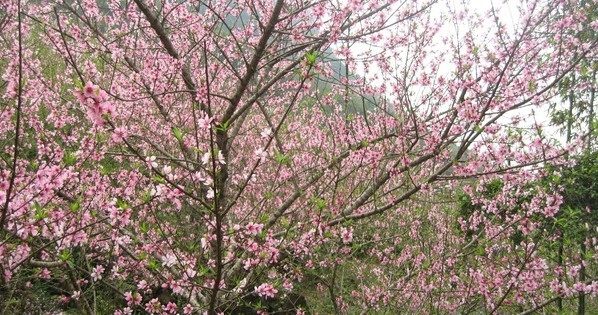
Experts Share How to "Control" Peach Blossoms to Bloom Right for Tet
This year, peach blossoms bloomed quite early, even though Tet is more than a month away.
Temperature is the decisive factor for flowering time
As the 2026 Lunar New Year approaches, prolonged warm and sunny weather due to a leap year has caused peach blossoms to bloom profusely in many places. Even though it is more than a month before the Lunar New Year of the Horse (Bính Ngọ), the vibrant shades of Nhật Tân peach blossoms and wild peach blossoms are already dazzling at the Quảng An flower market. In peach gardens and growing households across many areas, petals have already burst into full bloom.
Serving the market for this year's Bính Ngọ Tet, farmers in Chợ Lách commune have grown over 1 million pots of various fresh flowers, with chrysanthemums making up a large portion. However, affected by the weather, about 30% of raspberry chrysanthemum pots have blossomed prematurely, forcing growers to sell them before Tet. Currently, flower growers are applying technical measures to prolong the blooming period and proactively sell off the flowers that have already opened.
According to Assoc. Prof. Dr. Đặng Văn Đông, Vice Director of the Fruit and Vegetable Research Institute, to ensure peach blossom trees bloom in time for Tet, growers must simultaneously regulate internal plant physiological factors and external environmental conditions. In terms of physiology, the most important aspects are the differentiation of flower buds and the dormancy state of the buds. The plant must grow vigorously in the preceding season and accumulate sufficient nutrients, especially carbohydrates, so that flower buds form well and are able to develop uniformly. The transition from vegetative to reproductive growth must be calibrated at the right time.
Regarding external conditions, temperature is the primary deciding factor. Peach trees are temperate deciduous plants that require a certain period of low temperatures to break bud dormancy; if winter is overly warm, buds are prone to early development and blooming before Tet, while prolonged severe cold delays blooming. Additionally, watering and nutrition must be modulated appropriately: restrict water and nitrogen before flower bud differentiation to "check" vegetative growth, then supply moderate amounts when it is time to stimulate bud development. Light and ventilation also affect bud quality and flower color.
"In short, to control peach trees to bloom right on Tet, growers must thoroughly understand the plant's physiological rules and proactively adjust temperature, irrigation, nutrition, and light according to each growth stage, rather than relying on a single technical measure," Assoc. Prof. Dr. Đặng Văn Đông stated.
Defoliation, bark ringing, and water regulation: How to do it right?
In production practice, techniques such as defoliation, bark girdling/ringing, and water and nutrient regulation are key technical tools that empower growers to proactively manage the flowering time of peach trees, but their efficacy is high only when combined coherently and at the right moments.
Defoliation (stripping leaves) is the most critical measure, directly stimulating the differentiation and development of flower buds. When leaves are stripped away, the flow of nutrients and growth hormones is concentrated into the buds, helping them develop faster and more evenly. However, defoliation must be based on the variety, tree age, and weather conditions of each specific year; stripping leaves too early can cause flowers to bloom before Tet, while doing so too late results in delayed or uneven blooming.
Bark ringing plays a supporting role by restricting the downward transport of assimilates to the roots, thereby increasing nutrient accumulation in branches and buds. This method is particularly effective for vigorously growing trees with many winter shoots. However, if improperly done or overused, it can weaken the tree and diminish its stamina after Tet.
Regulating irrigation water is a "soft" yet vital measure. Reducing water before flower bud differentiation helps suppress vegetative growth; conversely, when flower development needs to be accelerated, appropriate watering ensures buds develop quickly and open petals right on schedule.
Nutrition, especially the balance between nitrogen, phosphorus, and potassium, dictates bud and flower quality. Restricting nitrogen at year-end prevents winter flushing, while phosphorus and potassium help produce firm buds, large flowers, vibrant colors, and long-lasting blooms.
Assoc. Prof. Dr. Đặng Văn Đông concluded that there is no "panacea" method. Success in timing peach blooms for Tet hinges on the flexible coordination of technical practices, grounded in a deep understanding of the variety, plant physiology, and the specific weather patterns of each year.
Selecting healthy, beautiful peach trees
For consumers, selecting a healthy, long-lasting, and aesthetically pleasing peach tree or branch requires attention to several fundamental yet crucial criteria.
First is the physiological condition of the tree/branch. A standard peach tree or branch should ideally feature three generations: opened blossoms, buds about to bloom, and young buds. This distribution enables continuous blooming, extending the enjoyment period. Buds must be plump and firm, without blackening, shriveling, or dried tips; opened flowers should feature thick petals, vivid color, and no bruising or pest damage.
Second is the freshness and vigor of the tree/branch. For potted peach trees, the plant must look fresh, with healthy green young leaves (if any), smooth branches and trunk without shriveling, and no signs of shock from recent potting. For cut peach branches, select freshly cut ones with a moist cut surface, good branch elasticity, and no signs of desiccation or abnormal sap leakage.
Third is the overall shape and aesthetic value. A beautiful peach tree or branch should have a harmonious, well-proportioned structure among trunk, branches, and flowers; branches should be evenly distributed without tangling or lopsided canopies. For shaped bonsai peach trees, the form should be distinct, with well-arranged branches creating a natural and stable feel.
Fourth is suitability for the display space. Buyers should consider the height, canopy spread, and flower color to ensure harmony with the area, lighting, and interior palette; avoid picking a tree that is excessively large or too small for the designated space.
The expert concluded that a good peach tree or branch is not only beautiful at the time of purchase but must also be robust, resilient, and capable of sustained flowering. Careful observation of buds, blossoms, branches, and overall tree shape will help blossom enthusiasts select a worthwhile product to fully enjoy during the Tet holidays.