
How to choose beautiful and long-lasting ornamental kumquat trees for Tet
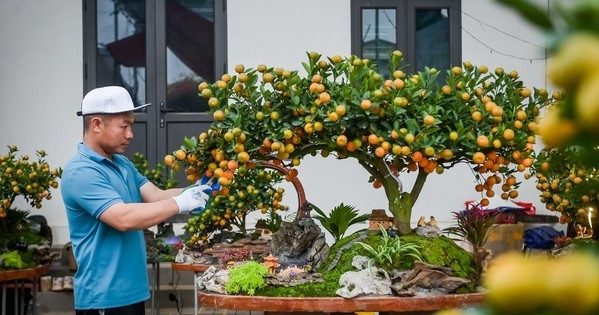
Miniature kumquat landscapes are favored by many for Tet decoration.Elements of a beautiful ornamental kumquat tree
With less than half a month until the Bính Ngọ Lunar New Year, the atmosphere of shopping for ornamental plants is buzzing across flower markets and social networks. This year, the mini kumquat trend is leading the way, particularly attracting young people and those living in apartments or small townhouses. Part of this is due to tighter family budgets. It's no longer about big pots - big money, and branches laden with fruit as in tradition, but rather small, delicate versions that are easy to "check-in" on Instagram and TikTok.
In addition, miniature kumquat landscapes or high-priced kumquat bonsai are also popular among a segment of customers. Trees used for landscape works are planted stably in jars or vases beforehand, having strong, well-developed root systems. To have a healthy kumquat tree, care requires higher technical standards compared to those grown in gardens. The stages of air layering, shaping, and fruit induction must be precise; otherwise, the tree's form will be ruined.
Assoc. Prof. Dr. Đặng Văn Đông, Vice Director of the Fruit and Vegetable Research Institute, stated that when choosing kumquat landscapes for Tet, especially high-value ones, buyers need to care for aesthetics – plant physiology – and display durability at the same time. These can be summarized into the following core criteria:
Overall form: the tree needs a balanced, harmonious shape (vertical, horizontal, cascading, dragon-phoenix...), a sturdy trunk and base, natural exposed roots, without broken sections or off-axis tilts. For high-value miniature kumquats, the form is the "soul" that determines artistic and economic value.
The canopy must be evenly round or follow the intended design; leaves should be deep green, moderately thick, not yellowed, and not shedding excessively. Healthy leaves are an important indicator of the tree's ability to hold fruit and its vitality throughout the Tet holiday.
Fruit should be distributed evenly across the canopy, with various stages (green – yellow – ripe) to create biological depth and extend the display time. Avoid trees that are overly laden with fruit but have weak branches, as they are prone to dropping fruit after a few days of display.
The harmony between the orange-yellow of the fruit – the green of the leaves – and the mature brown of the trunk creates high visual value. For premium trees, colors must be "soft" and natural, not unnaturally glossy due to chemical treatments.
"Buyers should observe for firm soil balls, healthy white roots without a rotten smell; trunks and branches should not be cracked or show signs of pests. These are the factors that determine whether the tree can maintain its shape and fruit throughout Tet," said Assoc. Prof. Dr. Đặng Văn Đông.
Compared to mass-produced kumquats, meticulously shaped miniature kumquats require much stricter selection of varieties and mother trees due to differences in biology as well as shaping and display techniques. For miniature kumquats, priority is given to lines with moderate growth, short internodes, flexible branches for easy bending, small thick leaves, and compact canopies; while also having good fruit-holding capacity with sturdy stems that rarely drop when the environment changes. The mother tree must be genetically stable and monitored for many years to eliminate individuals with large leaves, overly vigorous growth that easily "bolts," or those that fruit well but decline quickly.
Biologically, miniature kumquats must endure long-term growth control such as root pruning, root restriction, and continuous pruning, so only trees with durable vitality and a good balance between vegetative and reproductive growth can meet the requirements; the root system also needs to be strong and regenerate quickly to adapt to indoor display conditions. Technically, the input trees must have an appropriate physiological age of the trunk, beautiful bark with few scars, and a reasonably distributed primary and secondary branch system to minimize harsh bending that damages conductive tissues; many nurseries also apply grafting solutions, using hardy rootstocks that tolerate drought or waterlogging combined with canopies from selected mother trees to enhance durability and aesthetic value.
Avoid choosing trees with overly complex shapes
According to Assoc. Prof. Dr. Đặng Văn Đông, for miniature kumquats, one should not separate "beautiful trees" from "easy-to-care-for trees," because a tree is only truly beautiful if it maintains that beauty sustainably throughout the display period. Professionally, I believe the balance between aesthetics and careability is the most important criterion for kumquat enthusiasts, especially general consumers.
"Trees that are overly stylized or fruit-heavy but physiologically weak are often only beautiful for a very short time and easily drop fruit or turn yellow when brought indoors. Conversely, trees with harmonious shapes, compact canopies, moderately distributed fruit, and stable physiology will adapt better, have fewer risks, and retain leaf and fruit color longer. Therefore, consumers should prioritize trees with 'sufficient' beauty that are healthy and reasonably shaped by nurseries without excessive technical or chemical intervention; this is the smart choice to ensure the tree is beautiful during Tet, requires little care, and maintains its shape after Tet," said Assoc. Prof. Dr. Đặng Văn Đông.
The ideal time to buy miniature kumquats is usually 7–10 days before Tet, when the tree has stabilized physiologically and the fruit color has turned evenly but is not yet overripe. If bought too early (2–3 weeks before), the tree has to adapt longer to indoor conditions, making it prone to leaf drop, fruit drop, or wilting due to differences in light, temperature, and humidity; the owner also has to provide more care. Conversely, if waiting until right before Tet, the trees are often heavily "forced" to ripen for sale; while the fruit looks good, the tree's strength is reduced, and the display duration is short. Therefore, buying about a week before Tet helps balance aesthetic beauty – biological durability – and care risks, ensuring the tree keeps its shape, fruit, and stable color throughout the Tet days.
After bringing it home, proper care will decide if the miniature kumquat maintains its shape, leaves, and fruit throughout Tet. First, the tree should be placed in a cool, airy spot with diffused natural light, avoiding direct harsh sunlight and placement near air conditioners, stoves, or heat sources. Regarding watering, only water when the surface of the substrate is slightly dry, watering just enough to moisten, avoiding waterlogging which causes root rot; it is best to water in the morning and limit heavy watering in the evening.
In indoor display conditions, the tree should be moved outdoors or to a place with natural light every 1–2 days for a few hours to "recover" physiologically. The suitable temperature for miniature kumquats ranges from 18–25°C, avoiding sudden changes between indoors and outdoors. Throughout the Tet celebration, do not apply fertilizer or spray stimulants; just maintain stable moisture, air ventilation, and avoid strong impacts on branches and fruit, and the tree can maintain its fresh beauty, durable fruit color, and stable shape until the end of Tet.
When indoor temperatures rise or fall suddenly, miniature kumquats are very susceptible to physiological shock, manifested by leaf drop, fruit drop, or branch wilting. To minimize risks, first, stabilize the tree's position, avoiding placement near air conditioners, heaters, stoves, or places with direct sunlight.
If the house is too hot, move the plant to a cooler area for a few hours or open doors for ventilation, while gently increasing humidity by misting around the canopy (do not spray directly onto flowers and fruits). Conversely, when temperatures drop low, place the plant in a sheltered, draft-free spot with diffused light, limit watering with cold water, and avoid sudden environmental changes.
In both cases, the key principle is gradual adjustment to give the plant time to adapt; avoid continuously moving it over short periods. Proper implementation of these measures will help miniature kumquat bonsai retain green foliage, long-lasting fruits, and steady vitality throughout the Tet holiday.