
Content of the plan to protect the 2026 Mùa rice crop in Hải Phòng
White-backed planthoppers carry the dangerous virus for rice plants.Disease risks and the role of white-backed planthoppers
Southern Rice Black-Streaked Dwarf Virus (SRBSDV) has long been identified as one of the particularly dangerous pests on rice plants. With the ability to spread rapidly over large areas, the disease can cause serious damage to productivity and food output if not detected early and prevented in time. As the disease is transmitted via the white-backed planthopper as a vector carrying the virus, the risk of an outbreak is always high when planthopper density increases and the source of the disease exists in the fields from the start of the production season.
Therefore, investigating and monitoring the developments of white-backed planthoppers, as well as taking samples for analysis to determine the virus-carrying rate early, plays a particularly important role in predicting and forecasting the risk of disease occurrence. These activities help professional agencies issue timely warnings and guide localities and farmers to proactively implement effective prevention measures to minimize damage caused by the disease.
Production reality shows that in the 2017 Mùa crop, SRBSDV broke out into an epidemic in many provinces and cities in the Northern region, including Hải Phòng city, causing heavy losses to the crop industry. In recent years, although the disease has only appeared sporadically with low density and levels of harm, the risk of outbreaks and large-scale spreading is always latent. This is especially likely to occur under weather conditions favorable for the increase of white-backed planthopper density during the Mùa crop.
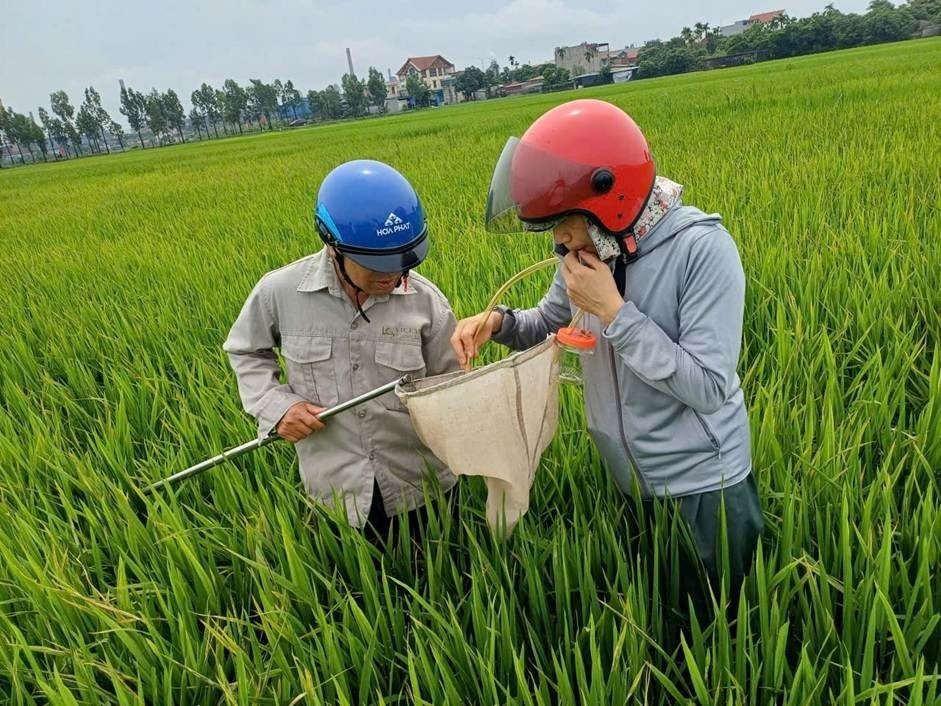
Officers from the Kim Môn Crop Production and Plant Protection Station conduct investigations and collect planthopper samples to monitor disease sources.Monitoring and communication plan
To proactively control and prevent the risk of disease occurrence and spread, and to protect rice production across the city, the Hải Phòng Department of Agriculture and Environment officially issued Plan No. 76/KH-SNNMT dated 26/5/2026 on preventing SRBSDV for the 2026 Mùa rice crop.
In this document, the Department of Agriculture and Environment has proposed comprehensive groups of solutions. Among them, strengthening the tracking and monitoring of white-backed planthoppers and disease sources right from the start of the season is identified as the top priority task. Simultaneously, communication efforts on disease prevention will be intensified through various forms such as providing information on media outlets, organizing conferences, technical training, and distributing guidance materials. These activities aim to help farmers recognize disease symptoms early to apply the correct technical measures. In particular, the agricultural sector recommends that farmers implement prevention measures starting from the seedling stage under the motto "prevention is key", involving the community and implementing across the board.
Field sanitation and seedling protection
Regarding specific technical measures, the Department of Agriculture and Environment requires localities to actively direct farmers to promote field sanitation by plowing under rice stubble, destroying ratoon rice, and clearing weeds on field banks to limit habitats for white-backed planthoppers and residual disease sources. Localities also need to arrange concentrated sowing and transplanting schedules, limit the planting of planthopper-susceptible varieties, increase the use of resistant varieties, and widely apply technical advances to improve the efficiency of integrated pest management (IPM).
For seedling protection, authorities recommend that farmers treat seeds before sowing, limit direct seeding in high-risk areas, and avoid sowing seedlings near roads or places with strong lights that easily attract white-backed planthoppers. In areas where the disease has appeared before or is at high risk, farmers should spray pesticides to kill planthoppers 3 to 4 days before transplanting to eliminate the transmission vector.
Handling disease outbreaks and coordinating implementation
The Department's plan also clearly states decisive solutions when the disease appears in the fields. Accordingly, when white-backed planthoppers carrying the virus are detected or infected rice plants appear, localities must immediately organize zoning, timely pesticide spraying, and pull up and destroy infected rice clumps to minimize spreading. For heavily infected fields, thorough destruction by plowing under must be carried out immediately after treating the planthoppers to prevent the disease source from spreading to other areas.
To achieve the highest efficiency for the plan, the Department of Agriculture and Environment assigned the Hải Phòng Sub-Department of Crop Production and Plant Protection to lead the implementation, strengthen forecasting work, and tighten inspections of businesses selling plant seeds, fertilizers, and pesticides in the area. Additionally, professional agencies, local authorities, media units, and mass organizations are requested to coordinate closely in communication work and guiding farmers to implement disease prevention measures synchronously and effectively, determined to protect a successful 2026 Mùa rice crop.