
Production and use of vermicompost
The value of vermicompost for soil
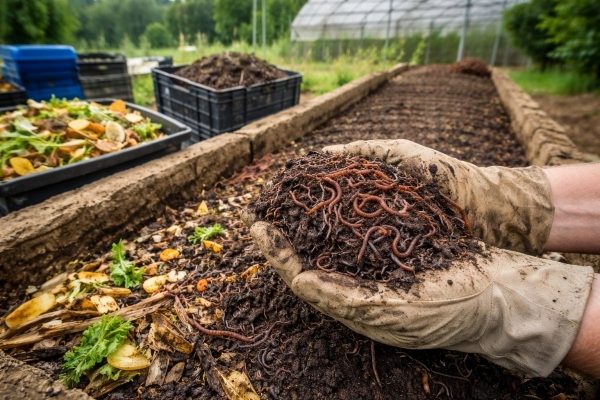
Vermicompost is becoming one of the effective solutions for soil improvement and crop yield enhancement, chosen by many farmers in sustainable agricultural production. This dark brown organic matter, a product of the earthworm digestion process, contains superior nutrient content: 5 times more nitrogen, 7 times more phosphorus, and 11 times more potassium compared to ordinary soil. As a result, vermicompost helps improve soil structure, increase porosity, enhance the quality of agricultural products, and extend freshness after harvest.
Production model at Sonoma Valley farm
In Sonoma County (California, USA), Jack Chambers' Sonoma Valley Worm Farm is a typical model at a commercial scale. Every month, the farm produces about 35,000 pounds of vermicompost. Mr. Chambers said that since 1992, the model has contributed to recycling more than 1.8 million tons of organic waste, preventing it from going to landfills and providing worms for household-scale organic composting.
For production, the main raw material is manure from organic dairy farms. The waste is pre-hot-composted to kill pathogens and weed seeds, then cooled and fed to the worms twice a week. At the farm, there are between 10 – 12 million worms working continuously in composting beds 80 feet long and 5 feet wide. When the compost has matured, the bottom layer is cut, collected, and screened to remove worms before packaging.
In addition to organic fertilizer, worms are also harvested for commercial sale. Chambers said many of his customers are large wineries in Napa Valley, and even celebrities like Oprah and Martha Stewart.
Worm farming in households
Not only suitable for farm scale, the worm farming model can be applied right in households or small gardens. According to expert Meghan Elliot, people only need to prepare one pound of Eisenia fetida red worms (equivalent to about 1,000 worms) along with two plastic bins, newspaper, leftover vegetable scraps, and daily food waste to start organic composting.
The process is quite simple: drill air and water drainage holes for the plastic bins, stack two bins, line them with moist newspaper as a "bed," bury some food scraps, and release the worms. The worms will gradually get used to the new environment and can eat an amount of food equivalent to their body weight every day. After a period of time, households can harvest vermicompost and leachate (worm tea) to fertilize plants, reducing the need for chemical fertilizers.
According to experts, developing worm farming not only brings benefits but also has economic value: recycling organic waste, reducing the amount of waste sent to landfills, supporting sustainable farming, and improving income for rural people.