
Carbon credits - The "golden key" for organic agriculture - Part 2: Nurturing the soil is nurturing life
To have organic products, we must first build the basic foundation of organic soil to increase content and sequester carbon.
When soil is more than just a "stand"
In the traditional agricultural thinking of previous decades, soil was often only considered a "stand" for farmers to pour in chemical fertilizers and pesticides to force trees to bear fruit. As a result, after many years, the land in key agricultural regions, including the Central strip, fell into a state of "poisoning", hardening, and loss of biological vitality.
Moving into 2025, according to a report from the Institute for Agricultural Environment, a warning was issued: More than 50% of agricultural land area in Vietnam is in a state of moderate to severe degradation. However, in organic agriculture (OA) "oases", the story is completely different. Organic soil is not just a nurturing environment for crops, but also a living entity, an efficient natural carbon sequestration "machine".
Science has proven that organic farming—by returning agricultural by-products to the soil, using microbial fertilizers, and planting cover crops—helps increase Soil Organic Carbon (SOC). Each 1% increase in soil carbon not only helps retain hundreds of thousands of liters of water per hectare but is also equivalent to pulling dozens of tons of CO2 out of the atmosphere.
In Hà Tĩnh, a locality famous for its scorching sun and Lao winds, maintaining soil moisture and nutrients is a struggle for survival. In 2025, Hà Tĩnh province made a bold impression by drastically implementing the Resolution on land accumulation associated with digital transformation and circular agriculture.
Typical models are in key orange-growing areas such as Vũ Quang, Hương Khê and organic rice in Cẩm Xuyên. Instead of burning rice straw or orange peels – an action that unintentionally emits large amounts of CO2 and fine dust – cooperatives in Hà Tĩnh have applied microbial technology to compost organic fertilizer on-site.
Ms. Nguyễn Thị Nguyệt, an owner of a VietGAP standard orange orchard in Mai Hoa village (formerly Đức Lĩnh commune, Vũ Quang district), shared: "Previously, my orange garden soil was dry and hard. When we switched completely to organic processes in late 2023, the topsoil has now become porous, and earthworms have appeared. Soil analysis results show that the humus content has doubled. We are not just selling delicious oranges; we are nurturing 'black gold' under the trees."
Regarding the implementation of organic-oriented agriculture, Mr. Nguyễn Hữu Ngọc - Director of the Agricultural Extension Center of Hà Tĩnh province, said that converting crop structure models, especially initially implementing OA in the locality, faced many difficulties because people did not believe in it and feared innovation. "But when they see 'real cash' flowing into their pockets from successful OA models, farmers then understand that doing organic is not just about cleaning, it's about smart economics."
Mr. Nguyễn Hữu Ngọc - Director of the Hà Tĩnh Agricultural Extension Center, shared about developing the OA model: "Now, farmers understand that doing organic is not just about cleaning, it's about smart economics and modern agriculture."Statistics by the end of 2025 show that Hà Tĩnh has developed more than 2,000 hectares of crops meeting organic and organic-oriented standards. More importantly, the province has begun establishing a digital map system for soil health, allowing for the tracking of carbon content accumulated in the ground in each farming area. This is the "competency profile" for Hà Tĩnh to be ready to enter the agricultural carbon credit market.
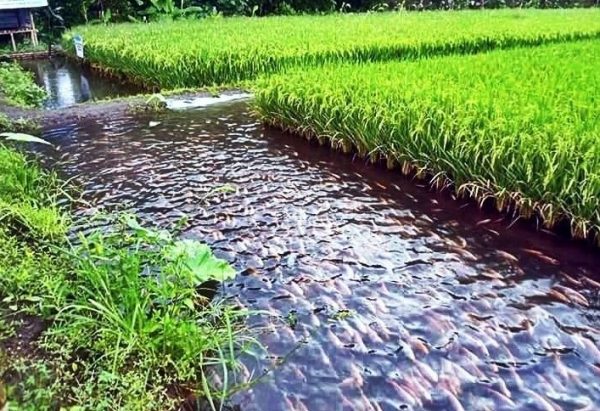
The rice-fish production model is bringing many benefits to farmersNurturing the soil is nurturing life
International and domestic agricultural experts, through the connection of the Vietnam Organic Agriculture Association at forums, have highly appreciated the "Rice - Ragworm" and "Rice - Fish" models in the coastal areas of Hà Tĩnh. These are highly sustainable "multi-layered value" ecosystems where soil and water are absolutely protected, creating a carbon credit amount 1.5 times higher than conventional rice cultivation.
That is, nurturing organic soil brings double benefits to civilized farmers. The first benefit is that healthy soil gives crops natural resistance, reducing chemical pesticide costs by 80-90%. The second benefit is the added value from the "low carbon agricultural product" brand. For example, Hà Tĩnh Oranges or Hà Tĩnh Organic Rice products in 2025 compete not only with sweetness and aroma but also with their "carbon footprint" index. Consumers in large cities like Hà Nội, TP Hồ Chí Minh and export markets are willing to pay higher prices for products that contribute to cooling the Earth.
From the perspective of an exporting enterprise, Mr. Phan Minh Thông - General Director of Phúc Sinh Joint Stock Company once shared: “The biggest change lies in awareness and mindset. Farmers are more conscious of sustainable production, applying international standards, traceability, and moving towards a circular economic model. Vietnamese enterprises have also moved from outsourcing to brand building, positioning products in the global market.”
Looking broadly from the Hà Tĩnh model, it can be seen that the carbon treasure is not far away but lies right in the mindset of the farmer. Hà Tĩnh is on the right track when it not only supports seeds and fertilizers but focuses on training and intellectualizing farmers. The organic-oriented fields and plots in this locality are reviving degraded lands, turning them into giant carbon sinks, opening up opportunities for sustainable wealth for civilized farmers.
The carbon market is no longer a future story but has become an essential part of corporate governance in the new era. However, for this treasure to truly be profitable, a synchronization of policies is needed, along with a synchronized ecosystem in which enterprises are the center and farmers are the subjects.
Therefore, the multi-value agricultural revolution directed by Prime Minister Phạm Minh Chính is exactly this: Combining the power of digital technology to measure the value of the land, combining industrialization thinking in agricultural processing, and maintaining the ecological "root" of rural Vietnam.
It can be said that organic soil – the carbon treasure beneath the farmer's feet – is the greatest asset that today's generation of farmers leaves for their children. We have the right to believe that OA is not just a lifesaver for the environment, but also the shortest path to turning Vietnamese farmers into true "green entrepreneurs" in the international market.