
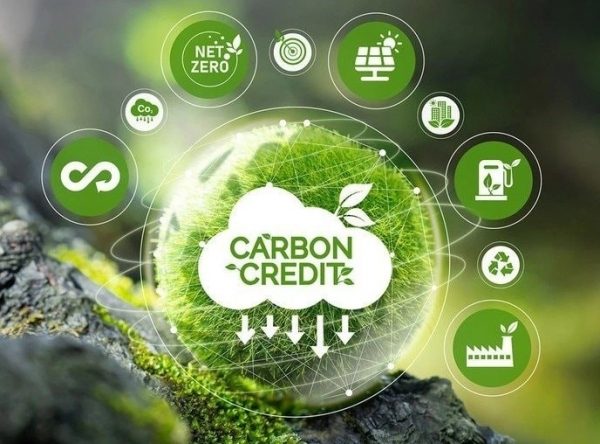
Carbon Credits - The “Golden Key” for Organic Agriculture - Part 1: A “New Gold Mine” in the Fields
At the Conference reviewing 2025 activities and rolling out 2026 tasks of the Ministry of Agriculture and Environment held on December 31, Prime Minister Phạm Minh Chính directed: "Agriculture remains the mainstay, but it must be digitalized, modernized, industrialized, driven by science, technology, and innovation; developing ecological agriculture, modern rural areas, and civilized farmers."
From a “Yield-Driven Mindset” to a “Green Value Mindset”
For decades, the benchmark of success for Vietnam's agricultural sector was export turnover and output volume counted in millions of tons. However, the price paid for those impressive numbers was often the depletion of soil resources and greenhouse gas emissions from synthetic fertilizers. Entering 2025, under pressure from the EU's Carbon Border Adjustment Mechanism (CBAM) and the Net Zero by 2050 commitment, the definition of “productivity” has fundamentally changed.
Organic agriculture, once perceived as a “luxury pursuit” for environmentalists, has now become the focal point of a new economic paradigm. At the 3rd Organic District World Congress (ODWC) held in Datong City, Shanxi Province (China) in late August 2025, experts reached a shared consensus: “Organic agriculture is the very farming method best capable of reducing emissions and sequestering carbon.”
Following this, the 8th Organic Asia Congress (OAC) in 2025, co-organized by the Vietnam Organic Agriculture Association and partner agencies from September 17–19 in Ninh Bình province, marked another major highlight for the agricultural sector. The event attracted nearly 600 delegates, including international guests from 33 countries and territories, comprising policymakers, experts, scientists, businesses, and agricultural development organizations.
Dr. Hà Phúc Mịch - President of the Vietnam Organic Agriculture Association speaking at the 8th Organic Asia Congress.Today, farmers are not merely food producers; they are becoming “carbon harvesters”. The year 2025 marked a historic turning point: organic fields no longer simply sell kilograms of clean rice or bundles of fresh vegetables, but have begun generating “green foreign currency” from the carbon credit market.
According to the Q3/2025 carbon market update report in Vietnam, the price of a carbon credit from sustainable agricultural projects on the voluntary market reached 12–15 USD/credit, an increase of nearly 40% compared to 2023. These numbers speak volumes. If a hectare of organic rice can reduce emissions and sequester roughly 5–10 tons of CO2 each year, farmers can earn an additional several million to tens of millions of VND without having to sell a single grain of rice yet.
Carbon Credits: A “New Gold Mine” in the Fields
The crucial factor in organic agriculture lies in the soil layer. Unlike conventional farming which causes soil compaction and releases carbon into the atmosphere, organic farming focuses on replenishing humus and beneficial microorganisms.
Data from the Vietnam Academy of Agricultural Sciences in 2025 shows that soil on organic farms contains 25–30% higher organic carbon content compared to chemically farmed soil. These thick humus layers act like a giant ‘sponge’, simultaneously retaining moisture to resist drought and locking carbon deep underground for decades.
Transitioning to organic not only helps agribusinesses meet stringent export standards for the European market (which began rigorously enforcing carbon footprint metrics in 2025), but also creates an absolute competitive advantage. An organic product bearing a certified “Low Carbon” label commands a 20% price premium over conventional organic products in supermarkets across Germany or France.
Vietnam holds immense potential for carbon credit projects in the agricultural sector.However, this carbon “gold mine” cannot be easily tapped without technology. A standout development in 2025 was the surge in technological solutions for measurement, reporting, and verification (MRV). Digitalization not only facilitates selling carbon credits but also improves farm management efficiency. With integrated data systems, international certification bodies can remotely verify the “cleanliness” and “greenness” of farms, reducing inspection costs by 50% compared to conventional methods.
Despite the enormous potential, the path to transforming organic farming into a “carbon industry” still faces hurdles. First is the fragmented scale of production. A farming household with only a few sào of land cannot independently commercialize carbon credits due to high verification costs. Therefore, the role of cooperatives and linkages with leading enterprises is a vital factor.
Second, while the legal framework for the domestic carbon credit exchange has been operating on a trial basis since 2025, it still requires more time to finalize financial and tax mechanisms. Farmers need clearer guidance on who will represent them in transactions and how benefits will be distributed.
At the Agricultural Forum 2025 on "Promoting Circular Economy in Agriculture" in mid-July, policymakers emphasized: “We should not view carbon credits as a subsidy, but rather as a specialized commodity of modern agriculture.”
Returning to Prime Minister Phạm Minh Chính's remark about a generation of “civilized farmers”, that vision is clearly taking shape across organic fields in 2025. These are farmers who know how to generate tangible value from what once seemed invisible—the air and the environment.
This also means organic farming does not stop at safeguarding consumer health; it carries a far greater mission: saving the planet and delivering lasting prosperity to rural communities. When the carbon economic equation is solved, Vietnamese organic produce will no longer suffer the cycle of “bumper crops, plunging prices”, because every grain of rice and every orange sold will inherently carry both environmental value and global business ethics.
The year 2026 opens with renewed expectations: Vietnamese agriculture will not only nourish the world with clean food, but also help cool the planet through its very own green, organic efforts.