
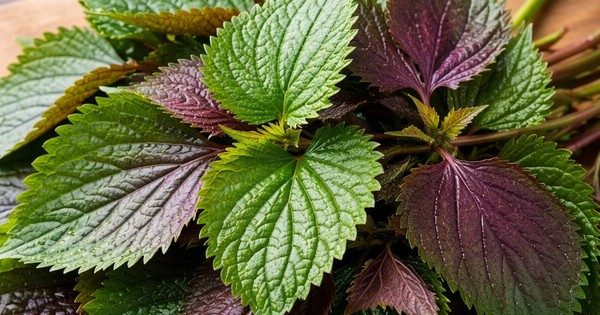
Perilla Leaves Contain More Vitamin C Than Lemons, Supporting Immunity and Skin Health
Perilla leaves are rich in beneficial nutrients for your health.
Recent studies have shown that perilla leaves are an exceptionally nutrient-rich herb. They are high in dietary fiber and essential minerals such as potassium and calcium, as well as carotene, vitamin C, vitamin K, and folic acid. The concentration of these nutrients is often significantly higher than that of common green leafy vegetables.
Perilla leaves are low in calories, providing about 45–60 kcal per 100 grams (g), equivalent to roughly 0.3 bowl of cooked rice (150 g/bowl).
1. Perilla leaves are rich in dietary fiber
Perilla leaves have a high fiber content of up to 7.3 g per 100 g, much higher than commonly eaten vegetables like Chinese cabbage, bok choy, celery, and leeks. Consuming 50 g of perilla leaves can provide nearly 15% of the minimum daily fiber requirement for an average adult. Getting enough fiber is beneficial for preventing constipation and improving gut health.
2. Perilla leaves have a high potassium content
The potassium content in perilla leaves is remarkably high, reaching up to 500 mg per 100 g—nearly double that of bananas, a common source of potassium—helping to regulate fluid balance in the body.
Eating 50 g of perilla leaves delivers 12.5% of an average adult's daily potassium requirement, which is beneficial for the prevention of hypertension.
3. Perilla leaves contain a significant amount of calcium
Although perilla is primarily used as a culinary herb, it contains an impressive amount of calcium, up to 230 mg per 100 g—more than double that of cow's milk—offering meaningful support for bone health.
While the absorption rate of plant-based calcium from perilla leaves is not as high as that from milk, its high concentration makes it a highly recommended dietary source of calcium.
4. Perilla leaves are rich in natural organic pigments
Compared to carrots, which are well known for carotene, perilla leaves boast an even higher beta-carotene content. Their beta-carotene levels reach 11,000 mcg per 100 g, four times that of carrots. Beta-carotene is not only a potent antioxidant, but it is also converted into vitamin A in the body, helping prevent dry eyes and xerophthalmia while contributing to healthy skin.
5. Perilla leaves contain more vitamin C than lemons
Perilla leaves contain more vitamin C than lemons, offering about 26 mg per 100 g, which helps strengthen the immune system and promotes collagen synthesis.
It is best to consume them raw after thorough washing, as cooking or heat exposure can degrade part of the vitamin C.
6. Perilla leaves are rich in vitamin K
Perilla leaves are among the top plant-based sources of vitamin K. While spinach—a staple leafy green—is already quite rich in vitamin K (482.9 mcg per 100 g), perilla leaves contain up to 690 mcg per 100 g, about 1.4 times higher. Vitamin K promotes calcium deposition in the bones and plays a vital role in bone health.
7. Perilla leaves are rich in vitamin B9
As a water-soluble B vitamin, folate plays an essential role in DNA synthesis, red blood cell production, and cell division. Vitamin B9 is typically abundant in leafy green vegetables and is a crucial nutrient for women who are trying to conceive or are pregnant. Perilla leaves provide 110 mcg of folic acid per 100 g; consuming 50 g raw can meet nearly 14% of the recommended daily intake. In fact, the general population also requires adequate folic acid to prevent megaloblastic anemia and hyperhomocysteinemia.
8. Perilla leaves contain perillaldehyde
Studies have found that perilla leaves contain perillaldehyde, a compound that not only gives perilla its distinctive aroma but also exhibits vasodilatory, antibacterial, antidepressant, anti-inflammatory, and antioxidant properties.
9. Perilla leaves contain phenolic acids
Perilla leaves also contain rosmarinic acid, a phenolic acid that serves as a primary active constituent in perilla. It exerts physiological benefits including antioxidant, antibacterial, immune-enhancing, and neuroprotective effects. Perilla is one of the plants in the Lamiaceae family with a relatively high concentration of rosmarinic acid, and the leaves contain the highest concentration of phenolic acids compared to other parts of the plant.
10. Perilla leaves contain other antioxidant compounds
Perilla leaves are also packed with flavonoids and polyphenols. Both flavonoids and polyphenols offer antioxidant and anti-inflammatory benefits. The total flavonoid content in purple perilla leaves and green (white) perilla leaves is 7.49% and 5.69%, respectively. Furthermore, purple perilla leaves contain significant amounts of anthocyanins, whereas green perilla leaves contain virtually none.