
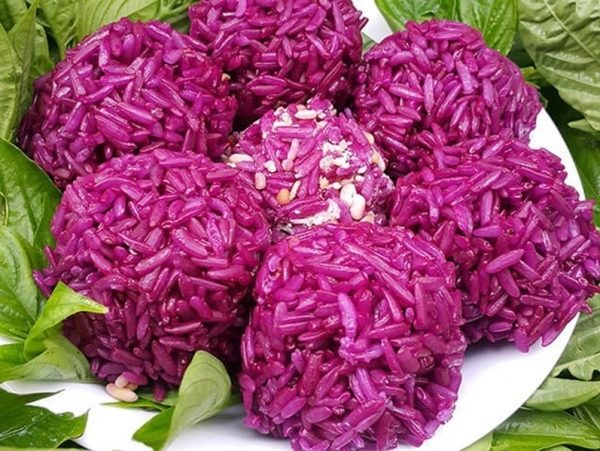
Magenta Plant (Lá Cẩm) - A Medicinal Herb and Safe Natural Food Colorant
The magenta plant.
Many synthetic dyes that were once commonly used in food have now been banned or restricted due to evidence linking them to cancer risks and other adverse health impacts. In this context, exploring and utilizing plant-derived colorants such as lá cẩm is strongly encouraged. Lá cẩm not only imparts an appealing color to dishes but also safeguards consumer health.
Dr. Huynh Tan Vu (Specialist Level 2) from the University Medical Center Ho Chi Minh City noted that in Vietnam, lá cẩm is one of the popular traditional ingredients used to impart a natural purple hue to delicacies such as sticky rice, bánh tét (cylindrical glutinous rice cakes), taro cakes, and steamed buns. Beyond its vibrant color and good shelf-life stability, multiple studies have shown that lá cẩm has a high safety profile and contains bioactive compounds with remarkable medicinal value.
Magenta plant (Cẩm, Lá cẩm), scientific name: Peristrophe bivalvis (L.) Merr. – Justicia bivalvis L.; Peristrophe roxburghiana (Schult.) Bremek. Botanical family: Acanthaceae.
1. Botanical Characteristics and Distribution
Lá cẩm is a perennial herbaceous plant widely utilized as a medicinal herb, food colorant, and hedge plant. It is primarily distributed across Southeast Asia, Southern China, and Taiwan. In Vietnam, lá cẩm thrives in many regions including Muong Khuong (Lao Cai), Moc Chau (Son La), Thai Nguyen, and others.
The plant grows well in moist soil, reaching a height of about 30–50 cm. The leaves are opposite, lanceolate to ovate-elliptic, 4–9 cm long, 2–4 cm wide, with a slightly sweet taste. The flowers are pinkish-purple with a distinctive two-lipped corolla. The plant produces ovoid capsules containing black seeds.
Lá cẩm thrives in humus-rich, well-draining soil with high humidity, lower temperatures, and low light intensity. Propagation is typically done via stem cuttings in early spring.
Four main varieties of the magenta plant are recorded in Vietnam:
Red cẩm: Oval leaves, dark green, hairy, without white markings.
Purple cẩm: Large, thin, light green leaves with large white markings along the veins.
Bright red cẩm: Thick, dark green leaves with a few white spots.
Yellow cẩm: Often wrinkled leaves, growing wild, also known as wild cẩm.
Currently, red cẩm and purple cẩm are the two varieties most widely cultivated for culinary and medicinal uses.
2. Chemical Composition and Pharmacological Effects
Numerous studies have demonstrated that extracts from lá cẩm offer significant biological value:
- Antibacterial activity: Ethanolic extracts from the leaves and stems of lá cẩm can inhibit food-spoilage bacteria such as Bacillus subtilis, Staphylococcus aureus, Pseudomonas aeruginosa, and Escherichia coli even at low concentrations.
- Antifungal activity: Methanolic extracts exhibit activity against Candida albicans.
- Anti-inflammatory activity: Several phytochemical compounds such as β-sitosterol, lupeol, oleanolic acid, and cyanidin have the ability to inhibit pro-inflammatory cytokines such as TNF-α, IL-1β, and IL-6.
- Antioxidant properties: Carotenoids and their derivatives help protect the retina and reduce the risk of age-related macular degeneration.
- Hepatoprotective effects: Polysaccharides extracted from lá cẩm have shown an inhibitory effect on enzymes that cause liver damage.
- Therapeutic potential: The compound Zizilan/Zilanine has been noted for its association with improving metabolic disorders, enhancing immunity, and applications in cosmetics as well as natural coloring. Ethanolic extracts have been found to be more effective than aqueous extracts in studies evaluating anticancer activity.
3. Applications in Traditional Medicine
Natural purple hue from lá cẩm - an alternative to synthetic food dyes…In traditional medicine, lá cẩm possesses a bitter taste, neutral property, and actions that clear heat, stop bleeding, reduce swelling, and eliminate toxins. It is utilized in the management of acute bronchitis, coughing up blood or vomiting blood, pulmonary tuberculosis, dysentery, as well as sprains and hematomas resulting from trauma.
In folk practice, lá cẩm is also decocted for drinking, ground into powder, or boiled for medicinal baths to support the treatment of digestive disorders and dermatological conditions. Bath water brewed from lá cẩm is often used for young children to soothe heat rash and boils, or applied topically to relieve swelling, pain, and inflammation.
Dr. Huynh Tan Vu noted that according to traditional medicine in several regions of China, lá cẩm has long been used as an adjunct in treating hypertension. Additionally, this medicinal herb is applied in cases of lung-heat cough, hemoptysis, swollen sore throat, oral ulcers, dysuria, as well as soft-tissue trauma such as abscesses, boils, swelling and pain from bruises, falls, or external bleeding.
Some traditional medical records also indicate that lá cẩm has been applied topically for venomous snake bites and may improve hematological parameters, supporting the prevention of intravascular blood clots.
4. Traditional Folk Remedies Using Lá Cẩm
- Treating bronchitis: Use 40g of lá cẩm stems and leaves, combined with 20g each of platycodon root (cát cánh), dwarf lilyturf tuber (mạch môn), and mulberry root bark (tang bạch bì); decoct in water and drink to resolve phlegm and relieve bronchitis.
- Managing acne: Take 1 bundle of lá cẩm and 1.5 liters of water. Wash the bundle thoroughly with clean water, add 1.5 liters of clean water, bring to a boil, then reduce heat to simmer gently for about 10 minutes before turning off the heat. Once the liquid cools to lukewarm, strain a sufficient amount to wash the face as usual without needing to rinse with fresh water; store the remaining liquid in the refrigerator for use over 3–4 days.
5. How to Extract Food Color from Lá Cẩm
Rinse fresh lá cẩm leaves thoroughly, remove the stems, and lightly crush or chop them before placing them in a pot with an adequate amount of water. Boil for approximately 10–15 minutes until the water turns a deep purple, then strain out the residue to collect the concentrated extract. This purple extract can be used to soak glutinous rice, mix into flour, or knead dough for pastries, giving the food a vibrant, natural purple shade. When cooking, maintain medium heat and avoid overcooking to ensure the color remains bright and does not turn dull.
Lá cẩm is not only a safe, natural colorant for traditional holiday dishes, but also a promising medicinal herb with numerous scientifically documented biological activities. Nonetheless, using lá cẩm for therapeutic purposes should be done under professional guidance to prevent any unintended risks.