
In life, perhaps not many people enjoy being inspected and scrutinized; however, in the organic vegetable village of Thanh Xuan commune, Soc Son, Hanoi, farmers actually consider the inspectors and controllers monitoring them to be their "treasured assets."
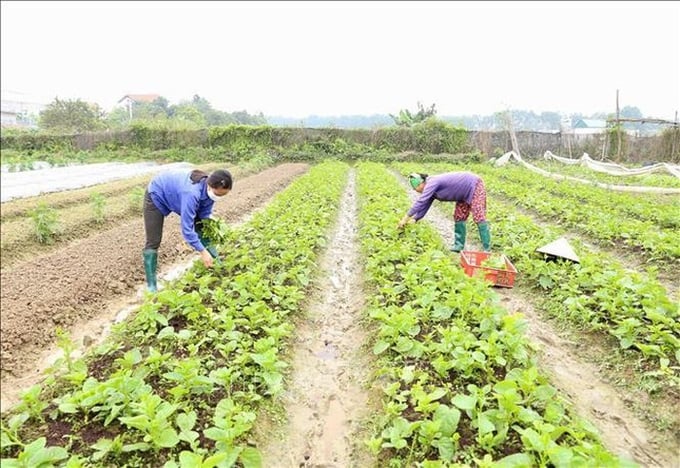
Inspection in Organic Vegetable Production
The Role of Inspection in the Thanh Xuan Vegetable Area
Recently, the Soi Bien clean food store chain hosted an appreciation ceremony for the farmers of the Thanh Xuan Organic Vegetable Inter-Group in Thanh Xuan commune, Soc Son district, Hanoi.
Alongside the appreciation ceremony was a seminar featuring representatives from organic vegetable farmer groups in Thanh Xuan commune, providing a forum for farmers to share their heartfelt thoughts and experiences.
Many stories were shared by the representatives, ranging from challenges and advantages to product commercialization. Notably, in response to the MC's question about how farmers resolved the market access issue so that consumers and the market would accept their produce, Ms. Nguyen Thi Minh Dung, leader of the Hoa Ly group, shared a story that won enthusiastic applause from the entire hall regarding the disciplined organic vegetable farming practices in Thanh Xuan commune and the remarkable dedication of the local people.
According to Ms. Dung, the organic vegetable farming process is extremely stringent; practicing organic agriculture is not about industrialization, but is entirely manual. Throughout more than 14 years of organic vegetable production, the local farmers have received dedicated support from PGS Vietnam (Participatory Guarantee System), with its Coordination Committee Head, Ms. Tu Thi Tuyet Nhung—one of the "treasured assets" of the organic vegetable farmers in Thanh Xuan, who has always wholeheartedly accompanied the community.
Ms. Dung shared that PGS serves as the bridge connecting three parties: producers, consumers, and retail buyers/distributors, fulfilling the role of inspecting and monitoring Thanh Xuan organic vegetable products.
Sharing the same perspective as Ms. Dung, Mr. Nguyen Van Vien, leader of the Thanh Cong group, affirmed that only through such thorough inspection and monitoring by PGS could the Thanh Xuan Organic Vegetable Inter-Group survive and thrive as it does today.
According to Mr. Vien, without inspection and monitoring, he and his fellow farmers might never have succeeded. The more rigorous the inspections and controls, the more encouraged he and the farmers feel, because PGS assurance is the key to bringing Thanh Xuan organic vegetables to the market. Representing the farmers, he gave wholehearted, two-handed support to having as many inspections and monitoring visits as possible to ensure output quality.
Deeply moved by the affection shown by the farmers toward PGS, Ms. Tu Thi Tuyet Nhung shared valuable insights about PGS during the panel discussion.
According to the "captain" of PGS Vietnam, practicing organic farming is demanding because products must strictly comply with standards to be recognized as organic, requiring tremendous effort and perseverance. Yet after harvest, selling the produce becomes another major challenge, as one cannot simply bring uncertified, unlabeled organic products to the market and expect people to believe in them.
Therefore, clear standards and a certification system are essential to help farmers secure market access after doing a good job in production. That was precisely why PGS Vietnam was established in 2008 with the support of IFOAM International, the world's leading organic agriculture organization, operating under the principle of the "Participatory Guarantee System," abbreviated as PGS.
Ms. Nhung highlighted that those who participate in monitoring to grant PGS certification are the farmers themselves, not external commercial inspectors. Within the PGS system, farmers must actively participate in peer reviews and inspections, taking direct responsibility for the products they grow.
Furthermore, the role of PGS is not only to assess quality, oversee standards, and issue certificates, but also to connect farmers with markets—distinctly different from third-party certification bodies that solely conduct audits and issue certificates.
Most importantly, today's PGS model serves a deeply humanistic purpose: empowering farmers to build their own capacity and guarantee quality under the oversight of diverse stakeholders. PGS is not a system where farmers simply certify themselves; rather, it is a transparent process where all stakeholders observe, inspect, and monitor together to make collective certification decisions.
Thus, PGS was born to help farmers assess their own quality while facilitating connections with the market through retailers. Today, PGS is present in hundreds of countries worldwide, including advanced nations such as the United States, Japan, Australia, and EU member states.
In closing, Ms. Tu Thi Tuyet Nhung expressed her heartfelt gratitude to the farmers for their determination and bold spirit, which have earned Thanh Xuan organic vegetables their strong reputation in today's market.
Need Advice on PGS Certification?
Contact the PGS Vietnam Coordination Committee for support.
Contact Us Now