
Nestled beyond the dykes on the alluvial floodplains of Kien Quoc Commune—now Nghi Duong Commune, Hai Phong City—the integrated rice-ragworm fields of Hai Au Viet Investment JSC and its partnered farming households are penning an extraordinary story of sustainable agriculture. Through nearly a decade of perseverance, these alluvial rice grains have officially earned a stringent "passport" to step out onto the world stage.
When the Alluvial "Pure Gold" Says No to Chemicals
Rice Cultivation Tied to the Habitat of Ragworms
Unlike many farming communities struggling to transition to clean production, farmers along Hai Phong’s alluvial plains have long been accustomed to entirely natural cultivation practices. Mr. Tran Van Trung, Director of Hai Au Viet Investment JSC, shared that the core reason lies in the presence of the palolo ragworm (sandworm)—a prized aquatic delicacy locals affectionately refer to as the land's "pure gold."
Ragworms are exceptionally sensitive to their living environment. Even a minute amount of chemical fertilizer or pesticide leaching into the soil can cause mass mortality. Consequently, to sustain an ecosystem where this specialty species can thrive, the entire field must remain completely chemical-free, preserving the soil's natural organic humus. Rice cultivation serves as a vital ecological link, fostering an ideal symbiotic environment where both rice plants and ragworms flourish side by side.
However, advancing from traditional farming to obtaining international organic certification has been a long and demanding journey. Beginning their transition in 2017, the enterprise and local farmers spent nearly a decade continually rehabilitating the soil and refining farming practices to meet the stringent standards of global markets.
Under the rigorous criteria of USDA Organic standards, many inputs that farmers once considered entirely natural were disallowed. Cattle manure from industrial feedlots, GMO-derived corn bran, and unverified inputs were thoroughly phased out. Over several years, the partnering enterprise worked hand in hand with farmers, patiently guiding adjustments to the smallest habits in the farming process. Their perseverance bore sweet fruit in February 2026, when the entire production area officially received international organic certification, proudly claiming its place on the global organic agriculture map.
"Layer Upon Layer of Hardship" on Muddy Ground
Behind this prestigious certification lay countless days confronting nature's unpredictability and harsh production conditions. Practicing organic farming means farmers must virtually accept yielding to pests and diseases, as all chemical interventions are strictly prohibited. In some seasons, just as the rice began flowering, stem borers swept through the fields. While conventional farmers could resolve the infestation with a few chemical sprayings, here, both the enterprise and the growers could only watch helplessly as yields took a steep hit.
Beyond pests, recurrent natural disasters in recent years have posed substantial challenges to local livelihoods. Powerful typhoons such as Typhoon Yagi struck right during the rice heading and flowering stages, flattening stalks, resulting in widespread unfilled grains and near-total crop loss. Simultaneously, salinity intrusion threatened to destabilize the delicate ragworm field ecosystem. To adapt, farmers flexibly stocked juvenile crabs and leveraged natural shrimp resources to sustain ecological balance within the fields. Timely interventions by local authorities to strictly regulate sand mining and river dredging also substantially mitigated salinity intrusion risks during the recent crop season.
Speaking with the Vietnam Organic Agriculture Electronic Magazine, Ms. Pham Thi Thuy, Chairwoman of the Nghi Duong Commune Farmers' Association, stated that the commune encompasses 787 hectares of rice land, including 40 hectares under organic cultivation and 250 hectares managed traditionally. To establish a sustainable organic rice zone, the Association collaborated with businesses and technical agencies to conduct training on biological techniques, shift farming habits, and roll out support policies for appropriate mechanization.
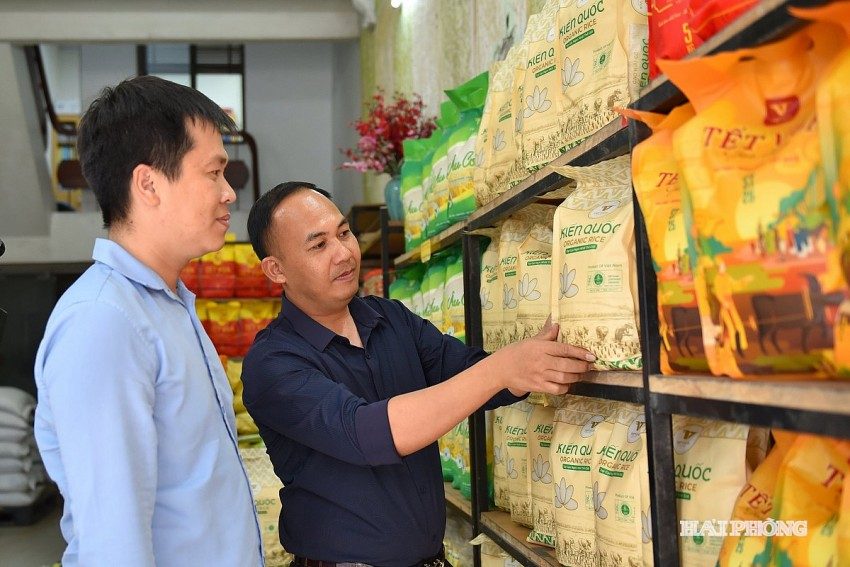
Today, the Kien Quoc organic rice brand is available in major supermarkets across Hanoi, Hai Phong, and Ho Chi Minh City, as well as exported to the United States. Maintaining clean rice production zones not only enhances agricultural value, but also paves the way for circular economy models (rice–aquaculture, duck herding, and composting by-products into organic fertilizer), ultimately boosting farmers' incomes.
Furthermore, in response to salinity intrusion challenges, the Commune Farmers' Association is proactively coordinating water monitoring, guiding growers to adopt salt-tolerant varieties, increase organic fertilization, and adjust crop structures to adapt to climate change and secure stable production.
Fields That Cannot Be Mechanized
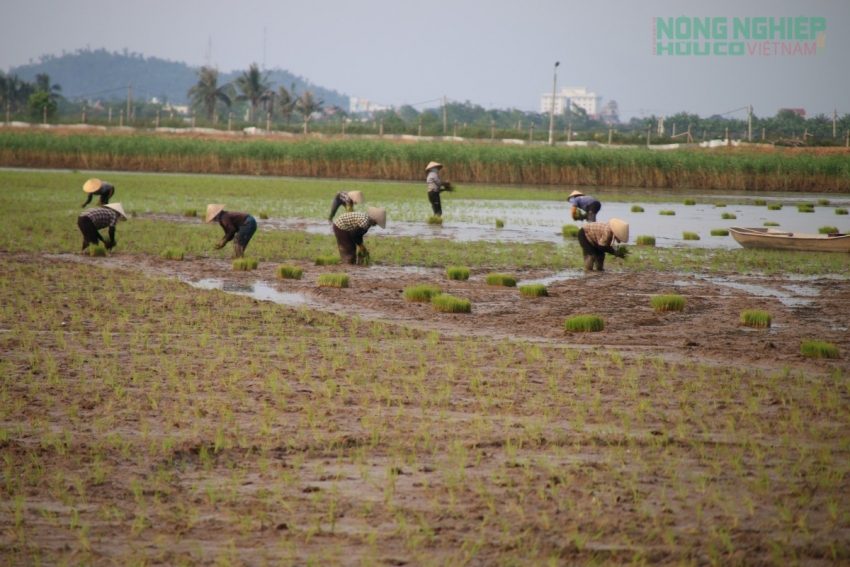
While many modern farming areas are accelerating mechanization, in the ragworm fields of Hai Au Viet Investment JSC in Nghi Duong Commune, almost every stage must still be performed entirely by hand. This necessity stems from the unique nature of the soil, which must remain soft, loose, and deeply muddy to suit the natural habitat and growth of ragworms. Consequently, mechanical transplanters or heavy agricultural machinery simply cannot operate in these fields.
From weeding and transplanting to crop tending, everything depends entirely on manual labor. Notably, most field hands today are elderly mothers and grandmothers, as younger generations have largely left to work in urban centers. Farmers must wade through deep mud for days on end to transplant each seedling by hand, with daily wages reaching around 500,000 VND. This figure underscores the immense effort and painstaking care invested into every grain of clean rice.
A "Storm-Dodging" Strategy to Safeguard Golden Harvests
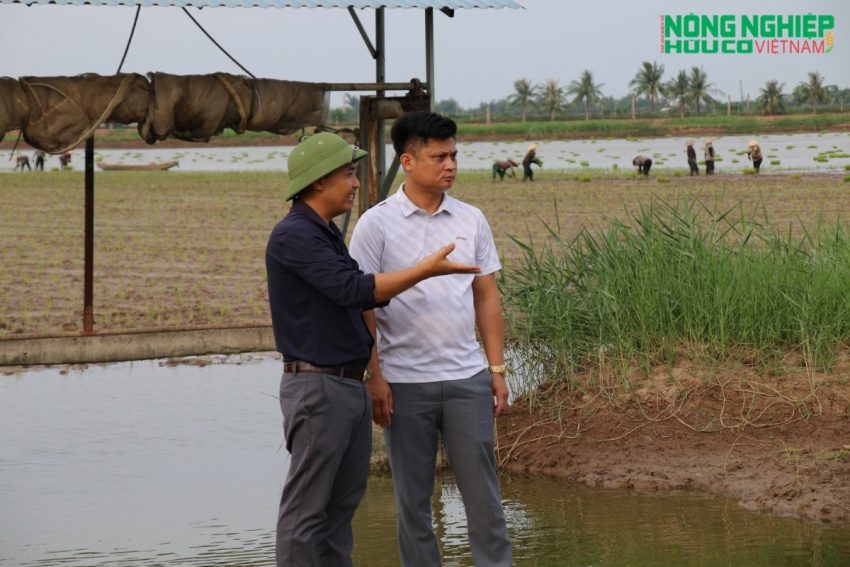
Facing increasingly erratic weather patterns, Hai Au Viet Investment JSC, along with key partnered households such as Mr. Do Danh Huong (16 ha), Mr. Luong Van Cuong (30 ha), Mr. Pham Van Xuan (35 ha), and Ms. Nguyen Si Nam (nearly 10 ha), proactively adopted a staggered planting strategy. Arranging varied sowing and transplanting schedules not only helps manage scarce manual labor but also minimizes risks from natural disasters. If one sector is unfortunate enough to be struck by storms, other areas can still yield a harvest, preventing total crop failure across the entire region.
It is precisely this demanding production process and high risk profile that create the unique value of alluvial organic rice. While conventional rice farming can readily achieve high yields, organic rice cultivated in ragworm fields yields only about 5 tons per hectare in favorable seasons, dropping to around 3 tons or fewer under adverse weather conditions.
In return, the grain's quality is acclaimed by experts and the market as a premium-tier product, distinguished by absolute purity and exceptional nutritional value. At present, the enterprise focuses production primarily to serve the Lunar New Year market, the season when the main-crop harvest delivers peak aroma and taste. Accordingly, the premium organic line retails for approximately 120,000 VND per kilogram, while the popular line remains stable at 68,000 VND per kilogram.
Affirming a Green Agricultural Brand in Northern Vietnam
This cooperative model across hundreds of hectares of ragworm fields isolated outside the dykes does more than prevent chemical cross-contamination from adjacent farming areas—it has become a beacon for the organic agriculture movement in Northern Vietnam. Having triumphed over grueling labor in deep mud, harvest losses brought on by natural disasters, and the exacting trials of international certification, the farmers of Nghi Duong Commune continue to stand proudly with optimistic smiles beside their enclosing dykes.
Within each of those tiny grains of rice lies the culmination of nearly a decade of perseverance, the purity of nature, and the aspiration to bring Vietnamese agricultural products to the global market through genuine quality. That arduous journey has proven that from seemingly ordinary alluvial lands, Vietnam is fully capable of creating world-class agricultural products—"pearls" worthy of representing the green agriculture of the future.
Source: VOAA
← Activity News