
Sea nettles (fire jellyfish) have appeared around Hon Gai beach and several coastal areas of Quang Ninh, causing itching, sharp pain, and burning sensations upon contact. In response to this situation, local authorities have implemented monitoring measures, issued warnings, and taken steps to ensure safety for residents and visitors.
Identifying sea nettles in Quang Ninh waters
Species characteristics and recorded areas
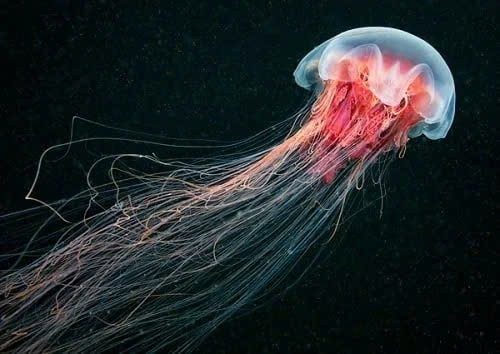
According to the Quang Ninh Department of Agriculture and Environment, the jellyfish species recorded belongs to the scientific genus Chrysaora sp., commonly known as sea nettles or fire jellyfish, within the family Pelagiidae. Scientists from the Hai Phong Branch of the Institute of Oceanography and the Institute of Oceanography analyzed the provided photos and videos, preliminarily identifying this jellyfish species. Chrysaora sp. has a bell diameter of approximately 15–20 cm, is semi-translucent or pale yellow, and often features brownish star-like patterns across its surface. Notably, the tentacles of this jellyfish can reach 2 to 3 times the bell diameter and contain stinging cells that cause severe irritation upon contact with human skin. Individuals stung by the tentacles may experience sharp pain, burning sensations, or a stinging prickle; the affected skin may develop red rashes, swelling, linear welts along the path of the tentacles, and in some cases, blistering. According to scientists, Chrysaora sp. is not a new species in Vietnam. It is typically distributed in coastal waters with relatively high salinity and clarity.
In Quang Ninh, scientists have previously recorded sea nettles appearing at relatively high densities in the Tra Co sea area. Typically, jellyfish appear in larger numbers from June to August; however, their timing and density distribution can fluctuate depending on seawater temperature and salinity conditions. The Quang Ninh Department of Agriculture and Environment has requested local authorities and beach management units to enhance public warnings and communications, advising residents and tourists to limit or refrain from swimming in areas where high jellyfish densities are reported. Beach operators have been urged to study and deploy protective netting, as well as assign appropriate personnel and equipment to collect jellyfish, thereby mitigating the risk of jellyfish and drifting tentacles entering bathing zones.
Proactively monitoring and identifying stinging marine species not only contributes to safeguarding public health, but also enables coastal communities to better manage marine ecosystems, ensuring safety for tourism activities and the sustainable utilization of marine resources.
Source: VOAA
← Activity News