
Building a national brand is not only about helping Vietnamese agricultural products sell more volume, but about selling at higher prices, delivering greater value to the country, to businesses, and especially bringing sustainable value to farmers.
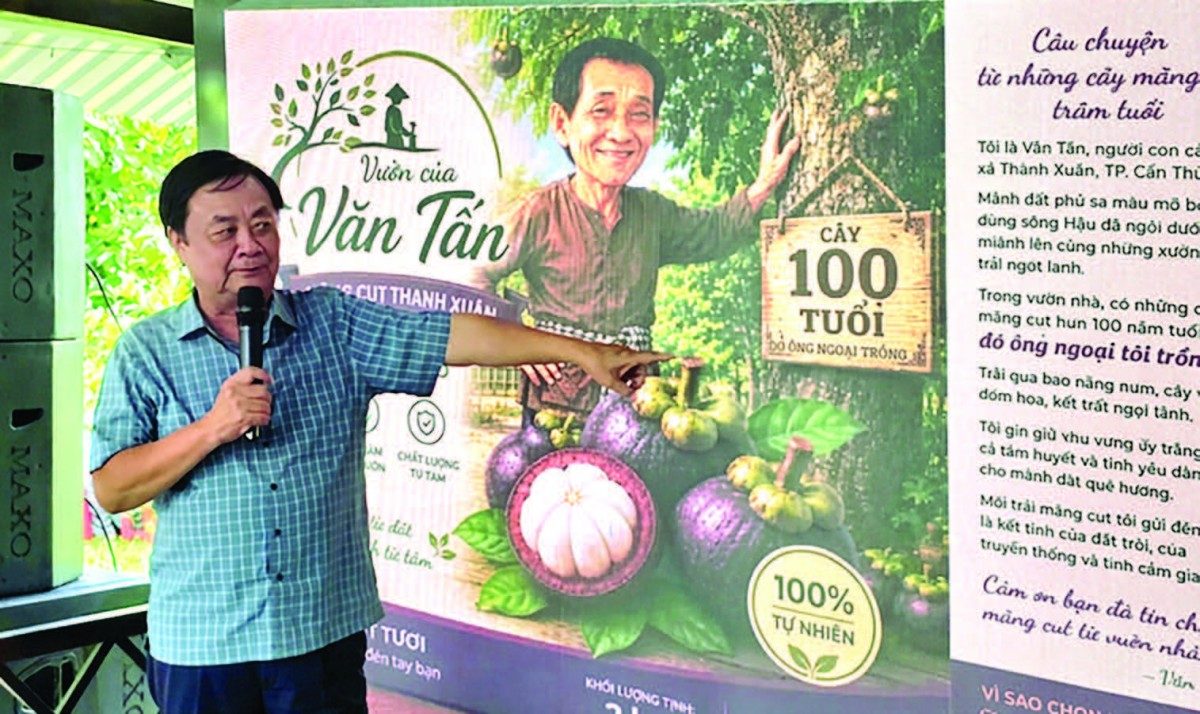
Don't Just Sell Products, Sell the Story Behind Them
The Product Story in Brand Building
For many years, Mr. Le Minh Hoan – former Vice Chairman of the National Assembly of Vietnam and former Minister of Agriculture and Rural Development – has consistently been associated with relatable stories carrying profound innovative thinking across agricultural development forums. He has served both as a policymaker and as a mentor guiding farmers along their journey of transition from agricultural production to an agricultural economy.
According to Mr. Le Minh Hoan, farmers today must not merely produce goods but also create value. That value lies not only in yield or output, but is also forged from brand identity, culture, history, and the narrative intertwined with the product. He has repeatedly emphasized that a mango is not merely a fruit to eat. It is also a story of the land, the farmers, traditional farming practices, the flood seasons, and fields along the riverbanks. Similarly, purple shallots, durians, or grains of rice can all become "cultural ambassadors" if their stories are told effectively.
“Don't just sell the product. Sell the story behind it,” Mr. Le Minh Hoan emphasized during a meeting with farmers and cooperatives.
In practice, we encounter many such examples. One prominent case frequently cited by economists and policymakers to illustrate the importance of branding is the story of durian. Both are durians, but Malaysia’s Musang King variety cultivated in Vietnam sells for 500,000 to 800,000 VND/kg. Meanwhile, Vietnam’s RI6 durian, whose quality is considered comparable, fetches at most around 100,000 VND/kg. This is the clear difference between a product with a strong brand and one that lacks branding, or whose brand is not yet established enough.
Another example is Korean ginseng. A single root may have an inherent value of just a few dollars, but South Korea does not simply sell the raw root; it has built an entire promotional ecosystem around it. The state endorses reputable ginseng display centers that virtually every tour group visiting Korea is guided to see, learning the history of Korean ginseng and purchasing processed value-added products. Concurrently, South Korea actively promotes the health benefits of Korean ginseng worldwide, even leveraging film and popular media...
Vietnamese Agricultural Products Step-by-Step Conquer Demanding Markets
According to economic experts, Vietnam is a world-leading exporter of numerous agricultural commodities such as rice, coffee, black pepper, cashews, fruits, vegetables, and seafood. However, up to the present time, nearly 80% of exported agricultural output has yet to establish its own brand, lacking distinctive logos or labels and falling short of full participation in global value chains. Therefore, the purpose of brand building is not simply to move higher volumes, but to achieve premium prices, bringing greater value to the nation, to enterprises, and particularly to farmers.
Practical experience from many countries worldwide shows that to successfully promote local specialties in export markets, great emphasis must be placed on cultivating, protecting, and preserving brand identity. Consequently, alongside zoning and planning high-quality agricultural production areas, special focus must be directed toward building and protecting the brands of Vietnamese agricultural products in the marketplace, especially overseas…
Building Brands Through Differentiation** <br>One of the challenges Mr. Le Minh Hoan constantly reflects upon is how to help Vietnamese agricultural products escape the trap of raw exports, market dependence, and perpetual price fluctuations.<br>In his view, going far requires building a brand. Building a brand requires creating differentiation. And differentiation does not come from offering identical products at lower prices, but from the intangible values added to the product.
To develop a national brand, the Government has approved and implemented numerous programs, including: the Vietnam Food Brand Strategy, the National Brand Program (Vietnam Value), the Intellectual Property Development Program to 2030, and the Sustainable Agriculture and Rural Development Strategy for 2021–2030 with a vision to 2050. These programs aim to establish and promote trademarks, trade names, geographical indications, and appellations of origin for Vietnamese goods both domestically and internationally, unlocking value and enhancing competitiveness.
Since 2022, A An Clean Rice has emerged as a pioneering Vietnamese rice brand entering the Japanese market—notoriously one of the most stringent in the world. By 2025, A An was selected by the Belc supermarket chain as a supply partner and continued its expansion into Europe. In 2025, A An’s rice exports to the EU reached approximately 1,000 tons, with projections to double in 2026. This figure reflects not only commercial growth but also the capacity to foster long-term brand trust.
Similarly, Loc Troi Group, with its “Com VietNam Rice” brand, has entered major French supermarket systems and progressively consolidated its foothold in this market by capitalizing on opportunities from the EU–Vietnam Free Trade Agreement (EVFTA).
By February 2026, Tan Viet Group's VIFON products officially hit the shelves of the Carrefour hypermarket chain in France. This milestone confirms that Vietnamese agricultural and food products can certainly access distribution networks in the most demanding markets when taking a strategic, brand-centric approach. VIFON’s story in France illustrates a systematic, well-planned market-entry model.
According to Mr. Vu Anh Son, Commercial Counselor at the Vietnam Trade Office in France, this success did not stem from luck, but was the outcome of a tightly knit partnership strategy. It represents a "three-legged stool" model comprising Vietnamese export enterprises, reputable local importers and distributors, and major retail corporations in France, supported directly by the commercial mission.
This synergy ensures that Vietnamese products not only reach international borders but also firmly secure their place on foreign supermarket shelves—where quality standards, traceability, and brand reputation are paramount.
A representative of Tan Viet Group also noted that establishing a presence in Carrefour marks an important milestone for executing long-term strategies and expanding into other retail chains throughout Europe. Clearly, this is no longer a short-term export mindset, but a dedicated journey to establish the brand standing of Vietnamese agricultural products globally…
Source: VOAA
← Activity News