
The Ho Chi Minh City People's Committee has issued an Implementation Plan for the Project on developing concentrated, safe vegetable production zones with guaranteed traceability linked to processing and consumer markets across the city through 2030. The plan aims to foster modern urban agriculture, apply high technologies, enhance agricultural product quality, and improve production efficiency.
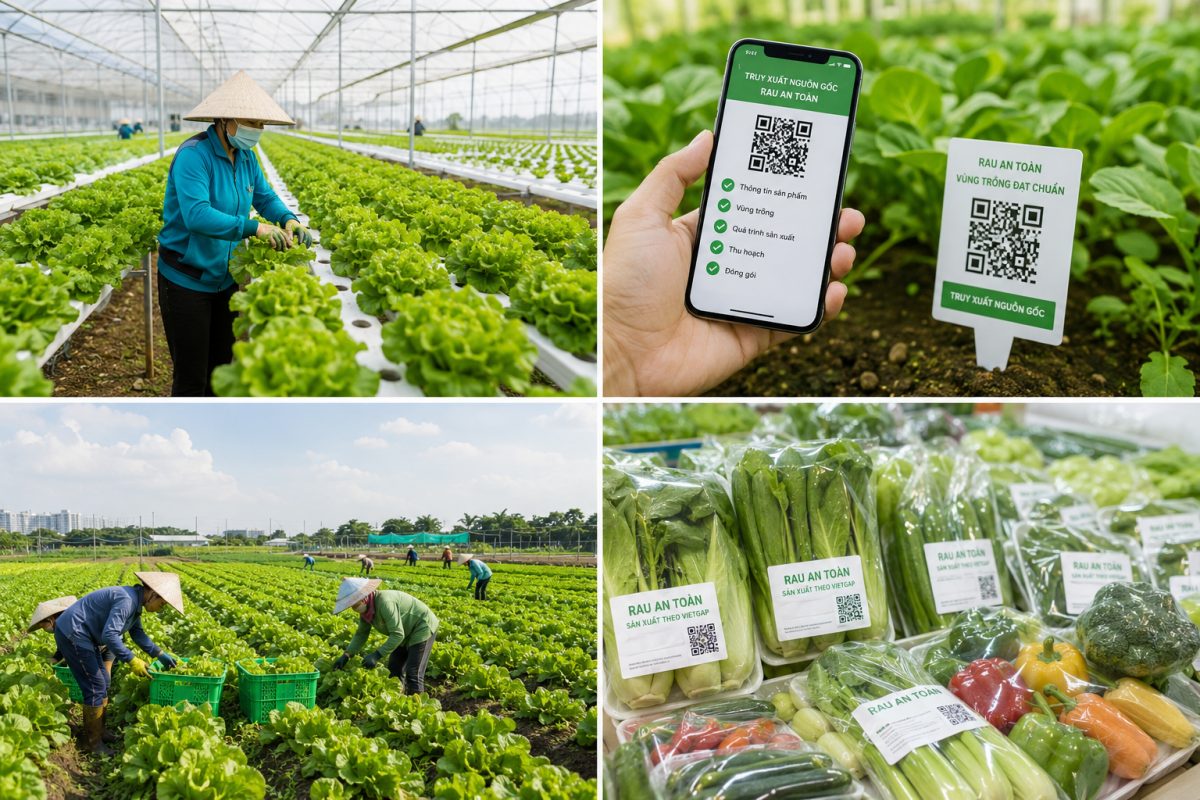
Developing Safe Vegetable Zones and Promoting High-Tech Applications
Targets for Area, Output, and Traceability
Under the plan, Ho Chi Minh City aims for a vegetable cultivation area of 5,500 hectares by 2030, a cultivated crop area of approximately 35,000 hectares, and an estimated output of 880,000 tons. High-tech vegetable cultivated area is projected to reach 12,000 hectares, while organic vegetable production area is expected to reach around 48–50 hectares.
The city strives for the proportion of concentrated, safe vegetable areas with guaranteed traceability to reach 60% of the total vegetable planted area. The average production value per hectare of vegetable land will reach VND 800 million to VND 1 billion per year, with high-tech vegetable products accounting for approximately 60–70% of the total vegetable sector's value.
In addition, the city will transfer 5–6 new vegetable varieties suited to local production conditions annually; supply approximately 800–900 tons of various vegetable seeds to the market, meeting the planting needs for 1.2–1.5 million hectares. The city will also support the development of 10–15 safe vegetable supply chains and strive for 100% of locally produced vegetable samples tested to meet safety standards.
According to the development orientation, concentrated vegetable production zones will be implemented across numerous communes and wards, such as Binh My, Nhuan Duc, Cu Chi, Thai My, An Nhon Tay, Dong Thanh, Hung Long, Binh Chanh, Ba Diem, Tru Van Tho, Phu Giao, Dat Do, Phuoc Hai, Chau Pha, Nghia Thanh, Xuan Son, Tan Khanh, Tan Uyen, Tam Long, Tan Hai, Long Huong, Thoi An, Long Nguyen, Hoa Loi, and others.
Among these, vegetable production meeting VietGAP and GlobalGAP standards will concentrate in the communes of Binh My, Nhuan Duc, Cu Chi, Thai My, An Nhon Tay, Dong Thanh, Hung Long, Binh Chanh, Ba Diem, Tru Van Tho, Phu Giao, Dat Do, Phuoc Hai, Chau Pha, Nghia Thanh, Xuan Son, and the wards of Thoi An, Long Nguyen, Hoa Loi, Tan Khanh, Tam Long, Tan Hai, and Long Huong.
High-tech vegetable production will concentrate in the communes of Nhuan Duc, Cu Chi, An Nhon Tay, Phuoc Thanh, Phu Giao, Dat Do, Phuoc Hai, Chau Pha, and Xuan Son; organic vegetable production will concentrate in the communes of Nhuan Duc, An Nhon Tay, Phuoc Thanh, and Hoa Loi ward.
Several specialty vegetables will continue to be developed, such as water spinach in Binh My and Dong Thanh communes; water mimosa in Thoi An ward; mop greens (Lasia spinosa) in Binh My and Phu Hoa Dong communes; Chinese yam in Phuoc Hai and Hoa Hiep communes; taro in Dat Do commune; and bamboo shoots in Tru Van Tho commune.
Ho Chi Minh City will also develop specialized vegetable farming zones and establish regional raw material linkages with other provinces, integrated with preliminary processing, processing, and distribution; and strengthen supply chain linkages among enterprises, cooperatives, and farmers.
Concurrently, the city will continue to research and breed new vegetable varieties; apply biotechnology, high technology, IoT, and AI in production; refine production protocols for safe and organic vegetables as well as circular agriculture; and promote the use of organic fertilizers and biological crop protection products.
Ho Chi Minh City will also organize training and technology transfer programs; build greenhouse and net-house production models; implement traceability systems; and step-by-step digitally transform vegetable production based on databases of soil, crops, environment, and weather.
Strengthening Trade Promotion and Expanding Consumer Markets
In trade promotion, Ho Chi Minh City will step up communication and training to raise awareness about safe and organic vegetable production, while improving the efficiency of market forecasting for agricultural produce and farming inputs.
For the domestic market, the city will continue supporting enterprises and cooperatives in branding safe vegetables linked with planting area codes and geographical indications; examine the organization of safe agricultural fairs and farmers' markets; and support brand promotion, market matching, and the diversification of distribution channels.
For export markets, Ho Chi Minh City will actively disseminate regulations on planting area codes, export packaging facilities, and requirements of import markets such as the United States, China, Japan, South Korea, and the EU; and support organizations and individuals in maintaining export eligibility and accessing new markets.
Furthermore, the city will enhance state management over safe vegetable production through inspecting production conditions, monitoring the quality of agricultural inputs, and checking food safety across production zones, preliminary processing, distribution, and circulation.
Ho Chi Minh City will also build and develop traceability systems, grant and manage planting area codes and packaging facility codes for domestic consumption and export, and step up inspections on compliance with plant protection chemical regulations in vegetable growing areas.
Assigning Specific Tasks to Departments, Sectors, and Localities
The Ho Chi Minh City People's Committee assigned the Department of Agriculture and Environment to take the lead, coordinating with departments, sectors, and localities to implement the plan; conduct training and technology transfer; provide guidance on safe vegetable production processes according to VietGAP, GlobalGAP, and organic standards; deploy traceability systems; grant and manage planting area codes and packing facility codes; and inspect production conditions and food safety.
The Department of Food Safety is tasked with training and disseminating legal regulations on food safety in vegetable preliminary processing, processing, and trading linked with traceability; deploying supply-chain food safety management models; and guiding and inspecting quality and food safety in the preliminary processing, processing, and trading of vegetables.
The Department of Industry and Trade will coordinate promotional activities, trade fairs, and exhibitions to build the city's agricultural brand, and support businesses with product promotion, e-commerce development, and market expansion.
The Department of Science and Technology will coordinate the implementation of science and technology tasks related to the development of safe vegetable production zones. The Department of Finance will coordinate and advise on budget allocations in accordance with regulations.
The High-Tech Park Management Board and the Agricultural High-Tech Park Management Board are assigned to research and develop new vegetable varieties, provide training, transfer safe and high-tech vegetable cultivation techniques, and build vegetable value chains.
The City Farmers' Union will coordinate outreach and encourage farmers to produce and market safe vegetables in compliance with regulations. Commune-level People's Committees are responsible for developing local safe vegetable zone plans, identifying concentrated production zones, and coordinating inspections of agricultural input quality, pesticide usage, and food safety across production, preliminary processing, and circulation.
Research institutes, universities, and enterprises in the city are encouraged to participate in scientific research, apply technology in safe vegetable production, preliminary processing, processing, and consumption, and establish sustainable production and consumption value chains.
According to the plan, departments, sectors, and commune/ward People's Committees shall periodically report implementation results annually to the Department of Agriculture and Environment before November 30 for compilation and reporting to the Ho Chi Minh City People's Committee and the Ministry of Agriculture and Environment./.
Source: VOAA
← Activity News